Let me tell you what made me look twice at BestQool.
I was doing the usual Amazon rabbit hole — comparing panels, cross-referencing specs, reading reviews that range from “this cured my soul” to “this is a space heater” — and I kept running into the same problem. Half the brands in this space play games with wattage numbers. They’ll list “1000W” on the title and you dig into the specs page and find the actual power consumption is 180W. Classic bait-and-switch.
BestQool’s listing for the Pro300 says 500W and backs it up. Machine-tested. That caught my attention.
This review is going to give you the actual numbers, what this panel does well, where it falls short, and whether the $764 price point makes sense compared to what else is out there.

What BestQool Is Actually Selling You
BestQool positions the Pro300 as a mid-tier to serious home panel — not an entry-level device, not quite flagship territory, but solidly in the “I’m committing to this” category. The white design is a bit different from the usual black panels you see everywhere, which I know sounds like a shallow thing to mention but it actually photographs better and doesn’t dominate a room the same way.
The headline claim is straightforward: higher power consumption equals better results. Not more LEDs, not bigger panels — more actual wattage delivered to fewer, stronger chips.
The formula they’re referencing is real physics: Dose (J/cm²) = Power Density (mW/cm²) × Time (s) × 0.001. More irradiance at the same session length means more total energy delivered to your tissue. That’s not marketing spin, that’s photobiomodulation basics.
The Specs That Matter
Wavelengths: 630nm, 660nm, 850nm, 940nm
Here’s where BestQool makes a different call than most panels, including the Hooga ULTRA1500 I reviewed separately.
Instead of 810nm + 850nm for near-infrared, BestQool uses 850nm + 940nm. The distinction matters:
- 630nm — surface-level red light, skin applications
- 660nm — the most-studied red light wavelength, deeper skin penetration
- 850nm — the workhorse NIR wavelength, solid research base for muscle recovery and joint tissue
- 940nm — deeper penetration than 850nm, less studied but used for deep tissue applications
The 940nm is a legitimate differentiator. It penetrates further than 850nm, which is relevant if you’re using this for things like hip or shoulder joint work where you actually need light energy to travel several centimeters into tissue.
Irradiance: 106.4 mW/cm² at 3 Inches
The measured irradiance is 106.35 mW/cm² at 3 inches, verified by professional instruments (LightLab laboratory). That’s in the effective therapeutic range — most researchers cite 10-200 mW/cm² as the working zone, with peak effects depending on application.
At 6 inches the irradiation area opens up to 46.5 × 17.4 inches, which is a meaningful coverage area for upper or lower body sessions.
For comparison with their own lineup: the Pro200 (same height, narrower) covers 46.5 × 10.8 inches at 6 inches and draws 340W. The Pro300 is significantly wider and 47% more powerful.
Physical Dimensions
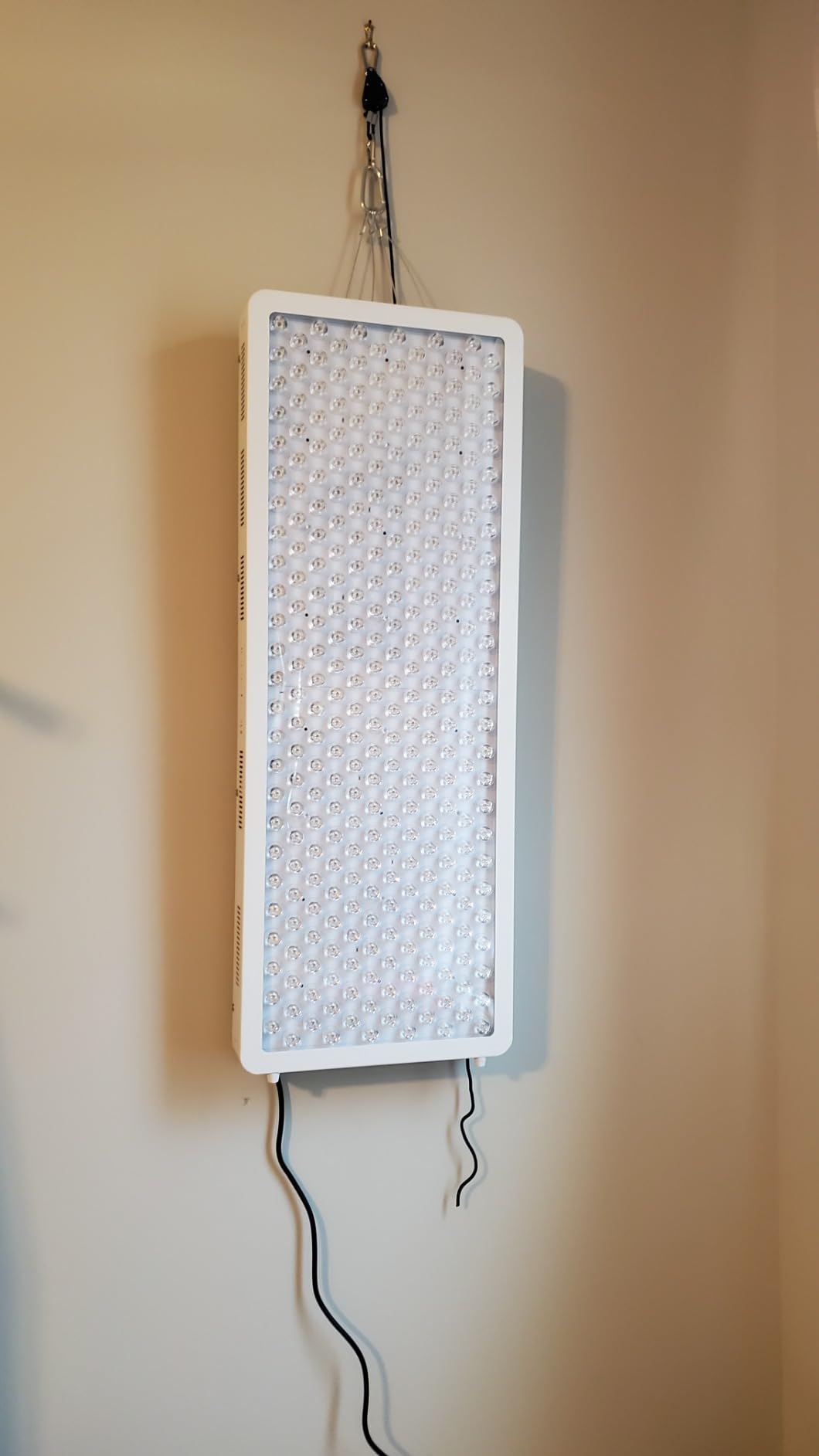
- Panel size: 33.5” × 13.4” × 2.75”
- Weight: 19.1 lbs (lighter than the Hooga ULTRA1500 at 28 lbs)
- Beam angle: 30 degrees (tighter than the Hooga’s 60 degrees — more concentrated, less spread)
- Power: 500W actual consumption
- LEDs: 300 dual-chip (2 chips per diode, vs Hooga’s quad-chip)
The 30-degree beam angle is worth understanding. A tighter beam means higher irradiance at close range but narrower coverage spread as you move back. At 6 inches you’re getting that 46.5 × 17.4 inch zone, but if you back up to 18 inches you’ll lose more intensity than with a 60-degree panel. For this panel, standing closer is the right call.
Pro300 vs Pro200: Which One Should You Get
This is probably the most common question if you’re shopping the BestQool lineup.
The Pro300 is the widest panel in the single-unit lineup — described as the largest panel for half-body coverage and wider than the Pro200. Both are roughly the same height, so you’re choosing between how much horizontal coverage you want.
If you’re primarily doing targeted work — lower back, shoulders, specific joints — the Pro200 covers what you need at lower cost and lower power draw. If you want broader coverage for things like full back sessions, chest and core work, or you’re a bigger person, the Pro300’s extra width earns its price premium.
Why BestQool Costs More Than Budget Panels
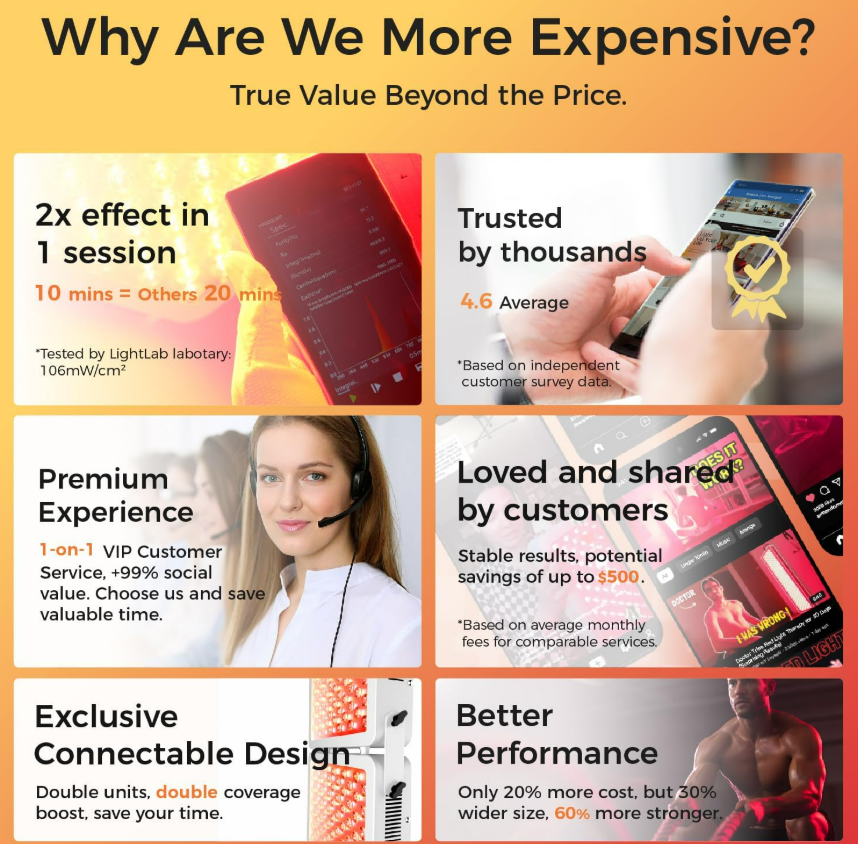
The comparison chart in their listing is pretty direct about what they’re differentiating on:
Dual-chip LEDs with 4 spectra vs single-chip with 2 spectra. This is real. Budget panels often use 660nm + 850nm only, skipping the 630nm for skin and the 940nm for deep tissue. You’re getting actual four-wavelength coverage here.
Verified 500W power consumption vs brands that claim 1000W and deliver far less. They’ve had the unit tested; the data is publishable.
Class II medical device certification. This isn’t a marketing checkbox — Class II certification requires documentation of safety and performance data. Not all panels in this space have it.
No EMF output, no flicker. Same story as with the Hooga — flicker-free drivers matter for daily use, low EMF matters if you’re standing in front of this thing for 20 minutes every day.
Modular expandable system. Two Pro300 units connected gives you 72.84” of total height — that’s actual full-body coverage from neck to ankles for most people.
Real Home Setups
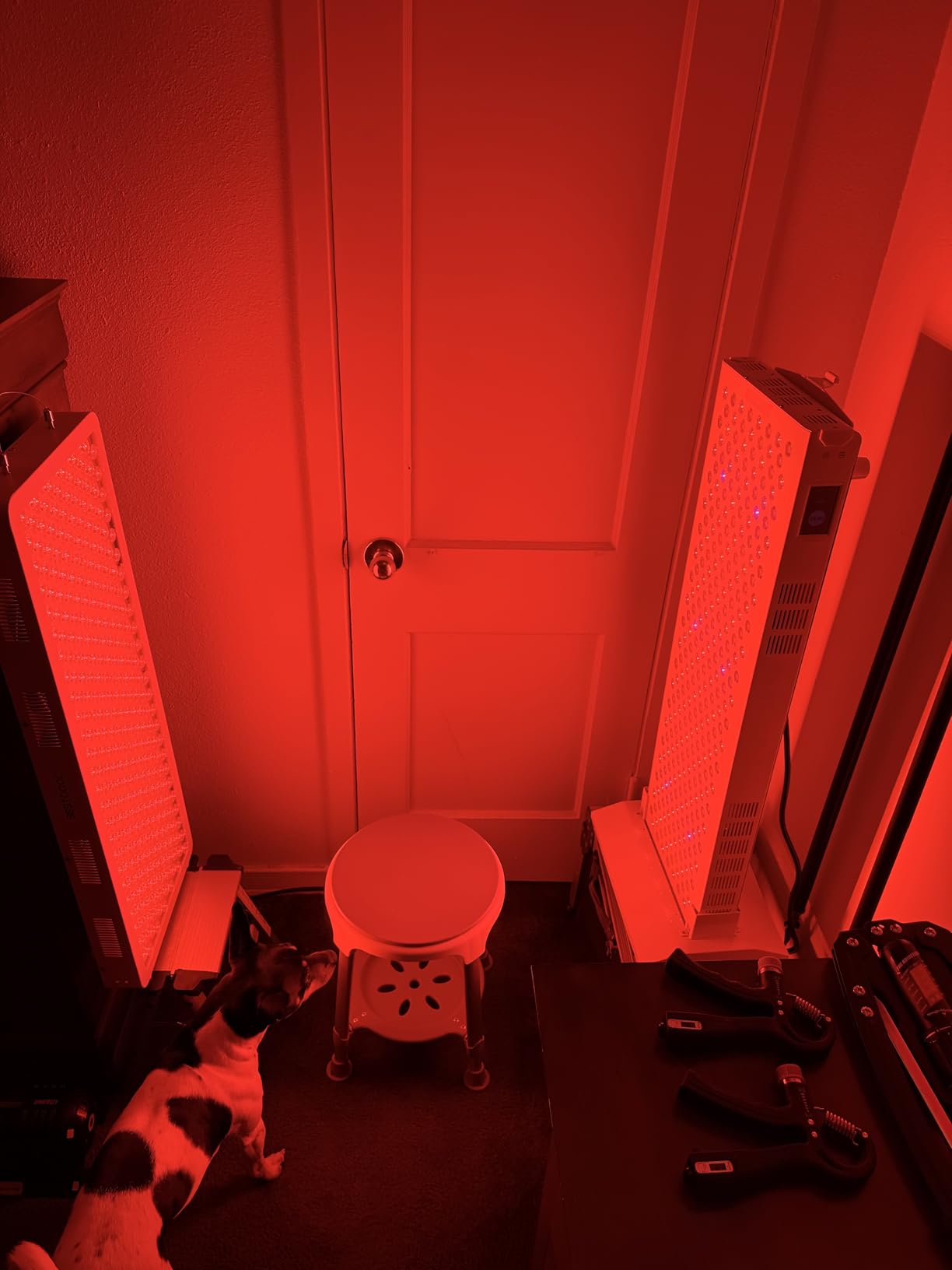
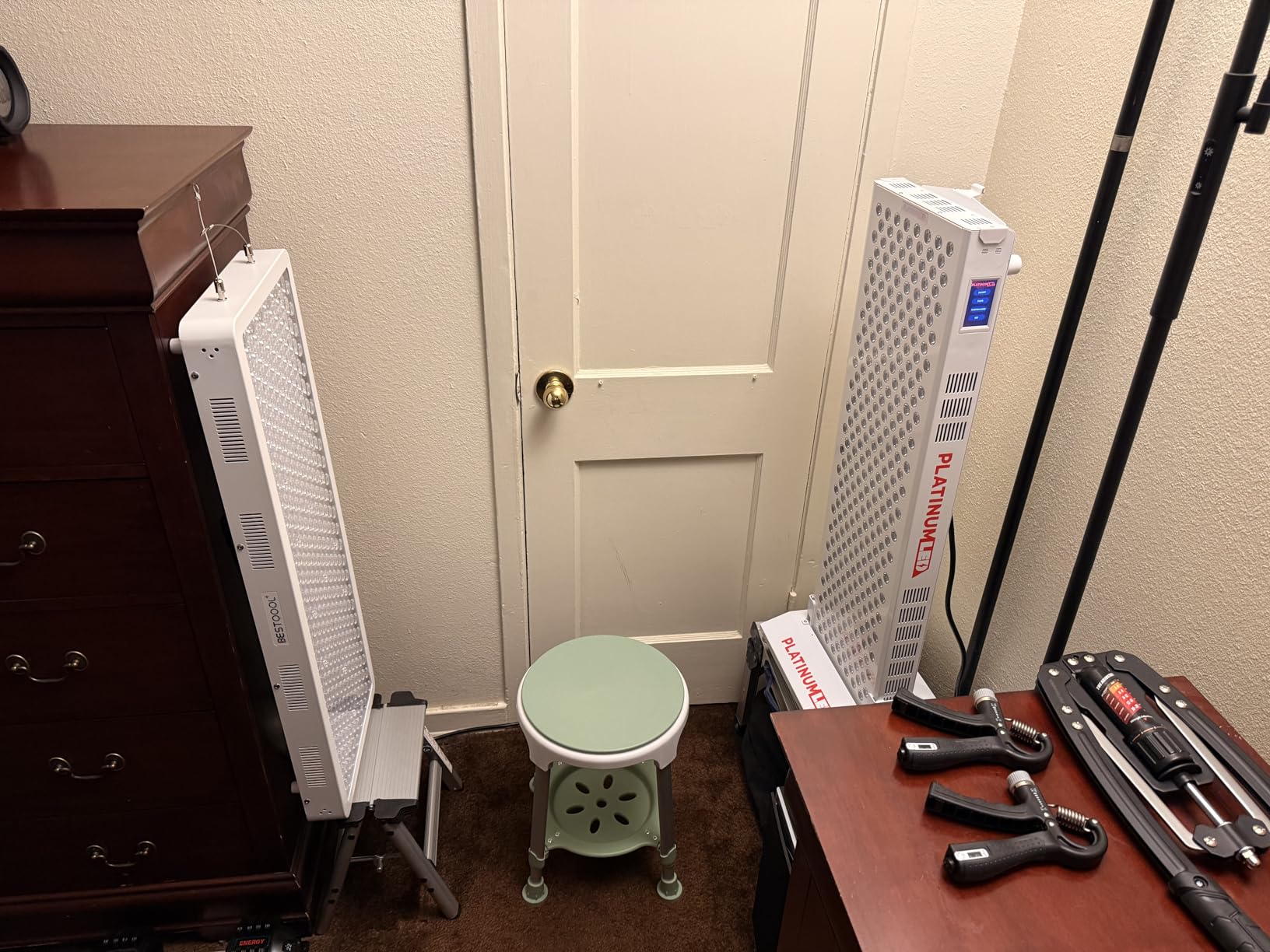
One thing I appreciate about how people are actually using these panels: they’re not building spa rooms. They’re fitting them into corners of bedrooms and home offices.
The user who set up this corner with two panels (including a Platinum LED next to the BestQool) is doing something smart: using panels from different angles to get wraparound coverage. The BestQool’s 30-degree beam angle means front coverage is solid; adding a second panel from the side addresses what a single panel can’t reach.
That overhead shot tells you everything about real-world home RLT setups — a stool between two panels in a small room, plus a dog who wants in on the action. This is the reality, not the staged wellness spa photos.
What BestQool Claims About Results
They present a timeline for what consistent users report:
Week 1: muscle tension reduction up to 30%. Weeks 2-3: noticeable improvement in movement comfort. Week 4 and beyond: chronic pain reduction up to 82% with consistent use.
The 82% chronic pain reduction figure comes from their own data, which means you should treat it as directionally useful rather than a clinical guarantee. That said, the photobiomodulation research base for pain management and inflammation is genuinely strong — this isn’t pseudoscience territory, it’s a legitimate mechanism being researched actively.
Important: these results require consistent use on bare skin. BestQool makes this explicit and it’s a real consideration.
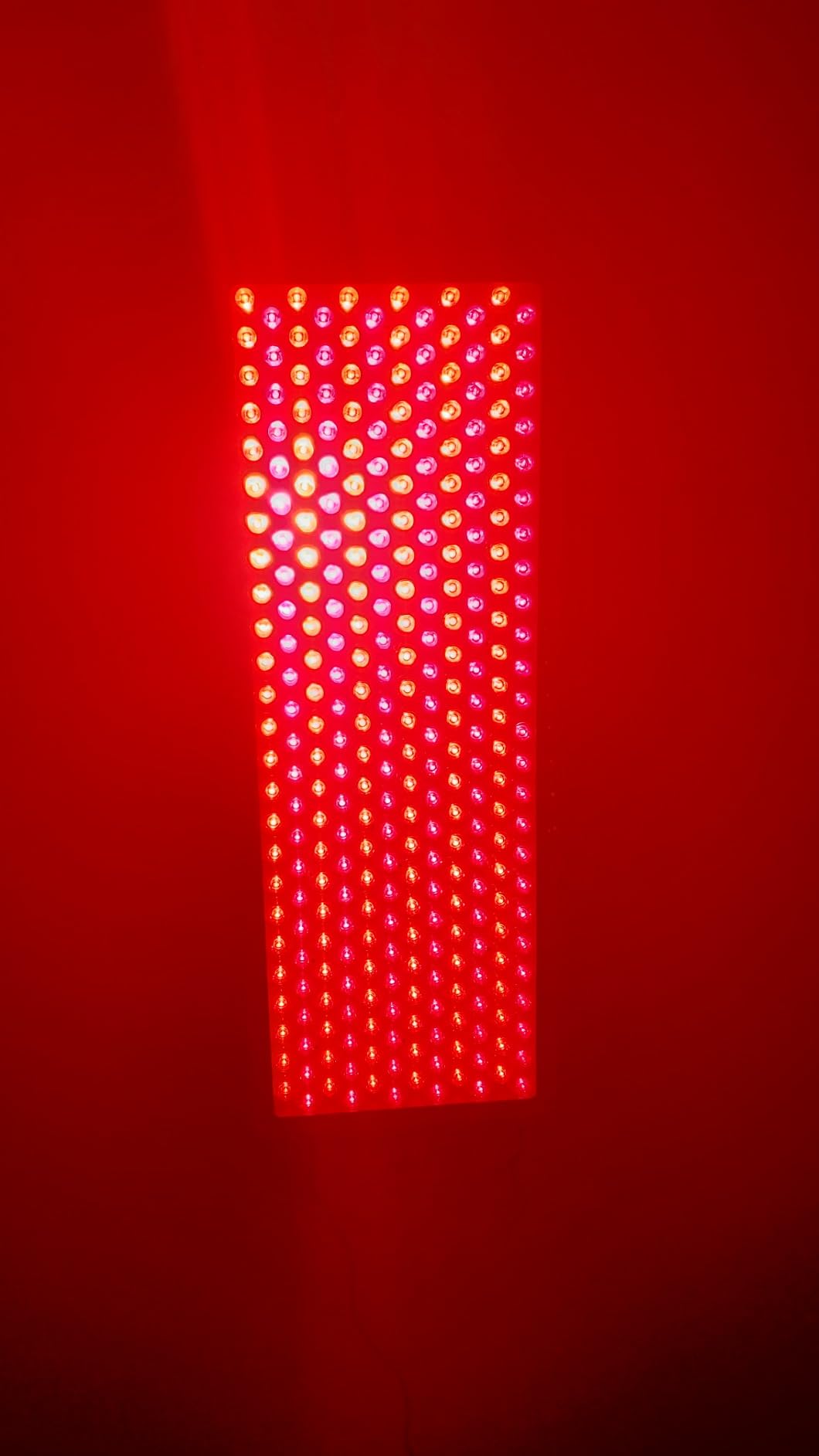
Clothing blocks most of the light — up to 90% of it. Red and near-infrared don’t penetrate fabric effectively. If you’re doing this in a t-shirt, you’re essentially wasting your time.
The Value Argument
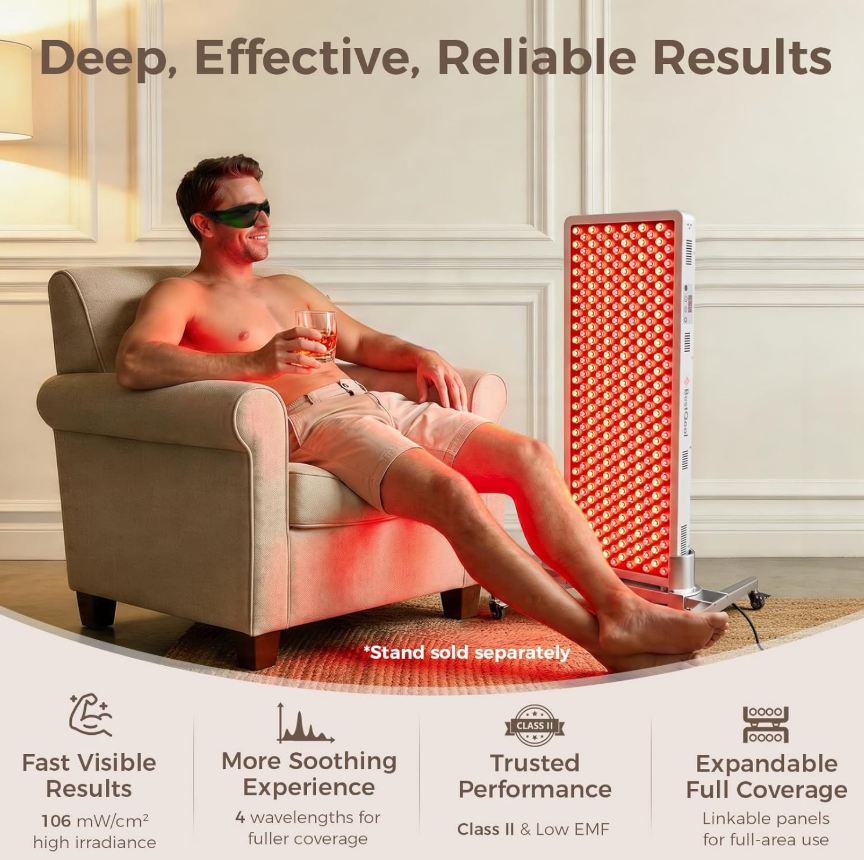
At $764 (with the occasional deal discount off the regular price), the Pro300 sits at a significantly lower price point than Joovv’s equivalent panels while delivering comparable or better irradiance specs. The math they use — 10 minutes with the Pro300 equals 20 minutes with lower-irradiance competitors — tracks if you compare mW/cm² numbers honestly.
The “20% more cost, 30% wider size, 60% stronger” claim in their value section refers to the step up from Pro200 to Pro300. That’s a straightforward geometric and power comparison. More honest framing than most brands manage.
Their rating is 4.5 stars across 316 reviews on Amazon, with 50+ sold in the past month — not the biggest sample size but consistent and not gaming-adjacent.
How to Use the BestQool Pro300 Effectively
The setup and session protocol matters as much as the hardware.
Distance: 3-6 inches for maximum dose. The 30-degree beam angle means the high-irradiance zone is closer to the panel than with wider-angle panels. Get close, keep sessions shorter, or back up and run longer sessions.
Bare skin only. This cannot be overstated. The 99% vs 10% absorption difference is enormous.
Session timing: 10-20 minutes per body area. Start at the lower end and work up — more isn’t always better with photobiomodulation, and there’s a real dose curve.
Consistency is the variable: The results data assumes daily or near-daily use. Twice a week will show slower results. This is a tool that rewards habit.
Eye protection: The NIR wavelengths (850nm, 940nm) are invisible but still interact with retinal tissue. Use the included or aftermarket IR-blocking goggles.
BestQool Pro300 vs BestQool Pro200 vs Hooga ULTRA1500
| Feature | BestQool Pro300 | BestQool Pro200 | Hooga ULTRA1500 |
|---|---|---|---|
| Price | ~$764 | ~$560 | $1,399 |
| LEDs | 300 dual-chip | 200 dual-chip | 300 quad-chip |
| Wavelengths | 630/660/850/940nm | 630/660/850/940nm | 630/660/810/850nm |
| Power | 500W | 340W | ~300W |
| Irradiance | 106 mW/cm² @3” | similar | 190 mW/cm² @3” |
| Beam Angle | 30 degrees | 30 degrees | 60 degrees |
| Weight | 19.1 lbs | lighter | 28 lbs |
| Modular | Yes | Yes | Yes |
The Hooga ULTRA1500 wins on irradiance (190 vs 106 mW/cm²) and beam angle coverage, but costs nearly double. The BestQool Pro300 wins on price, power consumption, includes 940nm instead of 810nm, and is significantly lighter. Which irradiance difference matters more depends on how close you stand and how long you session — at 12 inches, both panels deliver useful therapeutic doses.
Who Should Buy the BestQool Pro300
Good fit:
- Looking for a serious home panel under $800
- Want 940nm deep tissue wavelength coverage
- Prefer lighter hardware (19 lbs vs 28 lbs is real)
- Interested in upper body / half-body coverage to start, with option to expand modularly
- Value independent certification and verified power specs
Look elsewhere if:
- You want maximum irradiance (Hooga ULTRA1500 wins on raw output)
- You need wide-beam coverage at distance (60-degree panels spread better at 12+ inches)
- Full-body in one panel is the priority (two Pro300s gets you there, but that’s $1,500+)
Final Take
The BestQool Pro300 is a well-specified, honestly-marketed panel at a price that doesn’t require you to take out a small loan. The 500W verified power consumption, Class II certification, and 4-wavelength dual-chip LED setup give it real credentials in a market full of inflated claims.
The 940nm wavelength is a genuine differentiator for deep tissue work. The 30-degree beam angle rewards close-distance use. The modular design is legitimate if you eventually want full-body coverage.
For someone entering the serious home RLT market with a budget around $700-800, this is one of the better-value options available. The 316 Amazon reviews at 4.5 stars suggest it’s not just good on paper.
Check current price and availability on Amazon
Disclosure: This post contains affiliate links. If you purchase through these links, I may receive a commission at no additional cost to you.
This content is for informational purposes only and does not constitute medical advice. Consult a qualified healthcare provider before starting any new wellness protocol. These statements have not been evaluated by the FDA and are not intended to diagnose, treat, cure, or prevent any disease.