The EXESAS panel has been sitting on my radar for a while. Not because it came with a bunch of hype, but because one number kept standing out every time I compared it to other panels in the $500 range: 224 mW/cm² irradiance at surface.
That’s not a typo. Most panels in this price range deliver 80-130 mW/cm² at their closest measurement distance. EXESAS is claiming — and apparently measuring — 224 mW/cm² at surface contact. For reference, the BestQool Pro300 I reviewed earlier (a well-regarded panel at $764) measures 106 mW/cm² at 3 inches. The Hooga ULTRA1500 at $1,399 hits 190 mW/cm² at 3 inches.
A 200-LED panel at $529 claiming to outshine both. That’s either a legitimately impressive engineering decision or a number worth scrutinizing carefully. Let’s dig into both possibilities.

What Is EXESAS and What Are They Selling
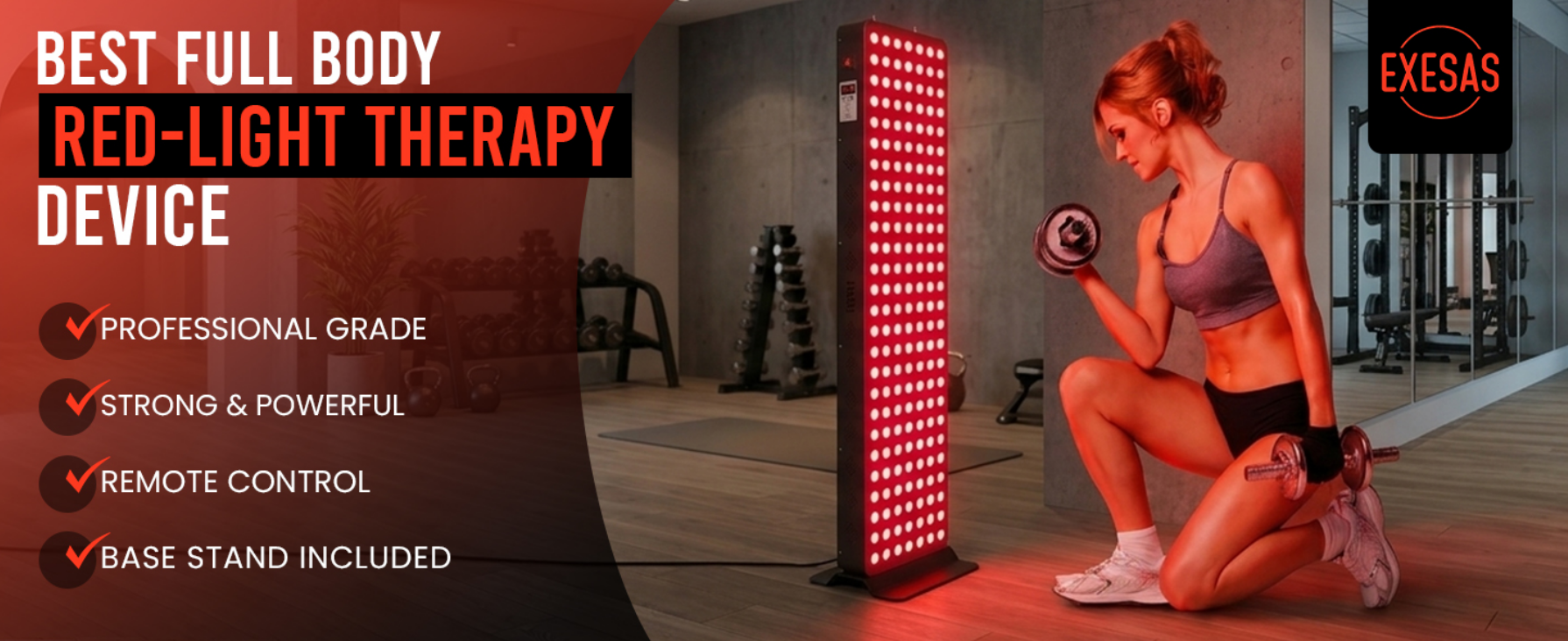
EXESAS is positioning this as a professional-grade home panel. The marketing is aggressive — “Best Full Body Red-Light Therapy Device,” medical grade LEDs, clinical-grade dual-chip tech. The usual superlatives. What matters is whether the specs hold up.
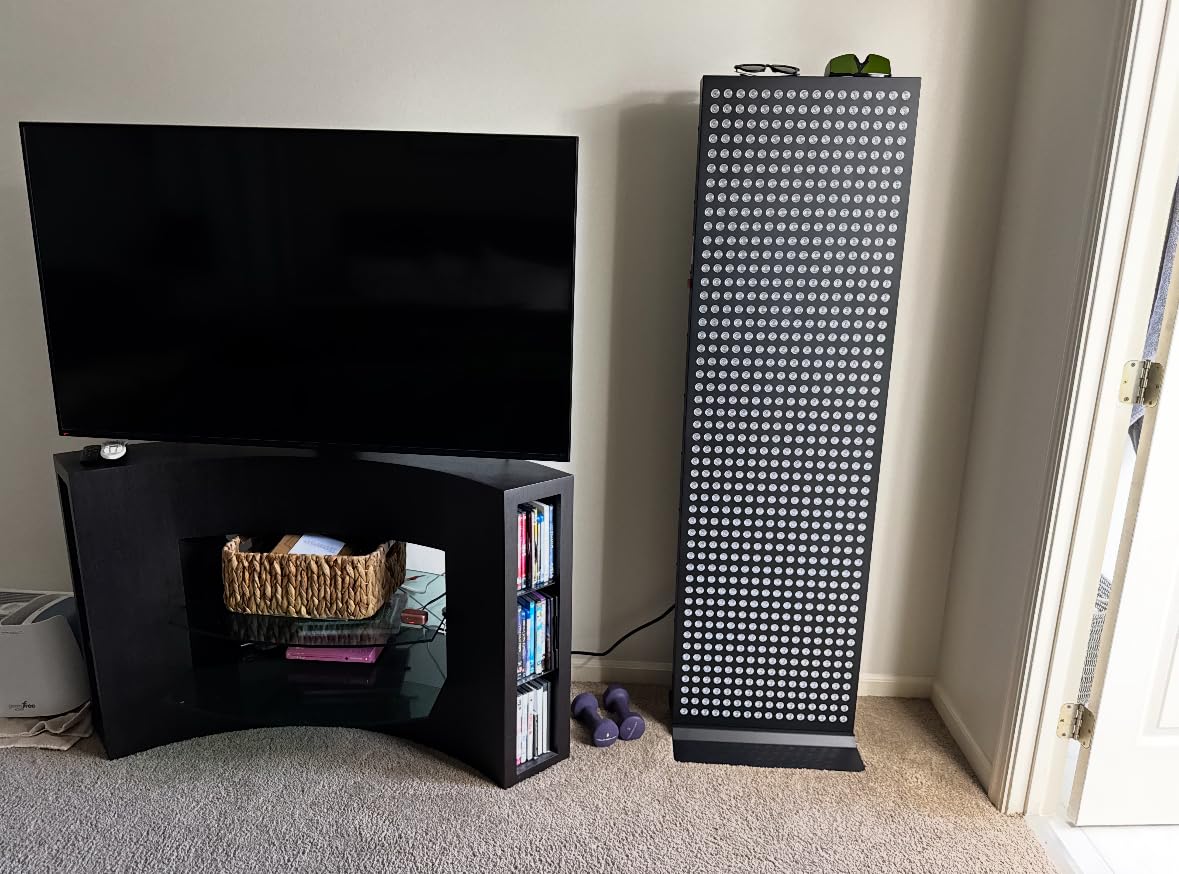
The core product is a 36-inch tall, 8.5-inch wide panel. Comes with a base stand included (that’s actually a meaningful differentiator — several competitors sell the stand separately). Remote control included. Black matte housing.
The Specs Breakdown
Physical Dimensions
- Height: 36 inches
- Width: 8.5 inches
- Depth: 2.6 inches
- Weight: 16 lbs
- Beam Angle: 30 degrees
Sixteen pounds is notably light. The BestQool Pro300 is 19 lbs, the Hooga ULTRA1500 is 28 lbs. For a panel you’re repositioning regularly or wall-mounting solo, that matters.
LED Configuration
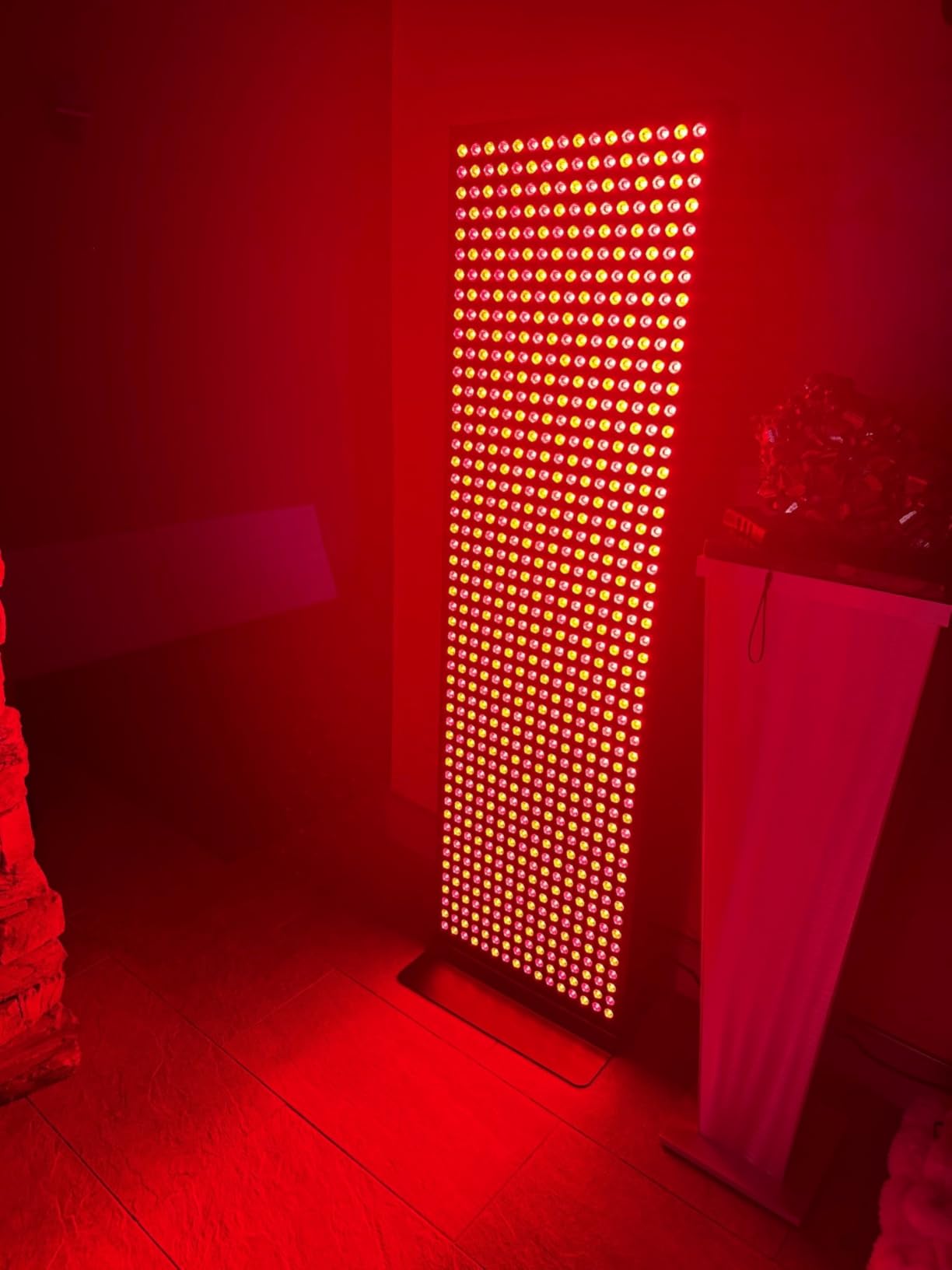
- 200 dual-chip LEDs
- Medical grade 5W per LED
- LED diameter: 0.75 inches
- LED lifespan: 100,000 hours
200 LEDs versus 300 in the BestQool Pro300 and Hooga ULTRA1500. This is where the “fewer but stronger” argument lives. Each LED here is running at higher individual wattage, which is what drives the irradiance numbers up despite fewer total diodes.
Power: 1000W Class, 377W Actual Consumption
Here’s where EXESAS does something transparent that I actually respect. They list both numbers — 1000W “power class” (which is a marketing label based on LED chip ratings at maximum theoretical output) AND 377W actual power consumption.
377W real wattage on a 200-LED panel works out to roughly 1.9W per LED of actual delivered power. That’s genuinely high. It’s what enables the elevated irradiance figures.
For context: a panel listing “1000W” that doesn’t also show actual consumption is almost certainly drawing 150-250W in reality. EXESAS showing 377W measured consumption is the honest version of the spec sheet.
Wavelengths: 630nm, 660nm, 810nm, 850nm
Same four-wavelength setup as the Hooga ULTRA1500 — two red (630nm for surface, 660nm for slightly deeper skin penetration) and two NIR (810nm and 850nm for deeper tissue work). Both wavelengths in the NIR range have solid research backing.
This is different from BestQool’s choice of 940nm instead of 810nm. Neither is categorically better — 940nm penetrates deeper, 810nm has more published research. Depends on your use case.
Irradiance at Distance
| Distance | Irradiance | Coverage |
|---|---|---|
| Surface | >224 mW/cm² | — |
| 3 inches | 194 mW/cm² | 38” x 12” |
| 6 inches | 134 mW/cm² | 42” x 15” |
| 9 inches | 116 mW/cm² | 45” x 18” |
| 12 inches | 103 mW/cm² | 49” x 22” |
The coverage at 12 inches — 49” x 22” — is genuinely wide. That’s a large enough zone to cover most of an adult’s back or chest in a single standing session without repositioning.
Note the 30-degree beam angle, same as BestQool. The irradiance drops meaningfully as you move back, so close-distance sessions are where this panel shines (literally). At 12 inches you’re still at 103 mW/cm², which is therapeutic range, but the high-intensity advantage you’re paying for requires getting closer.
The Control System
One of the better-thought-out aspects of this panel is the control interface.
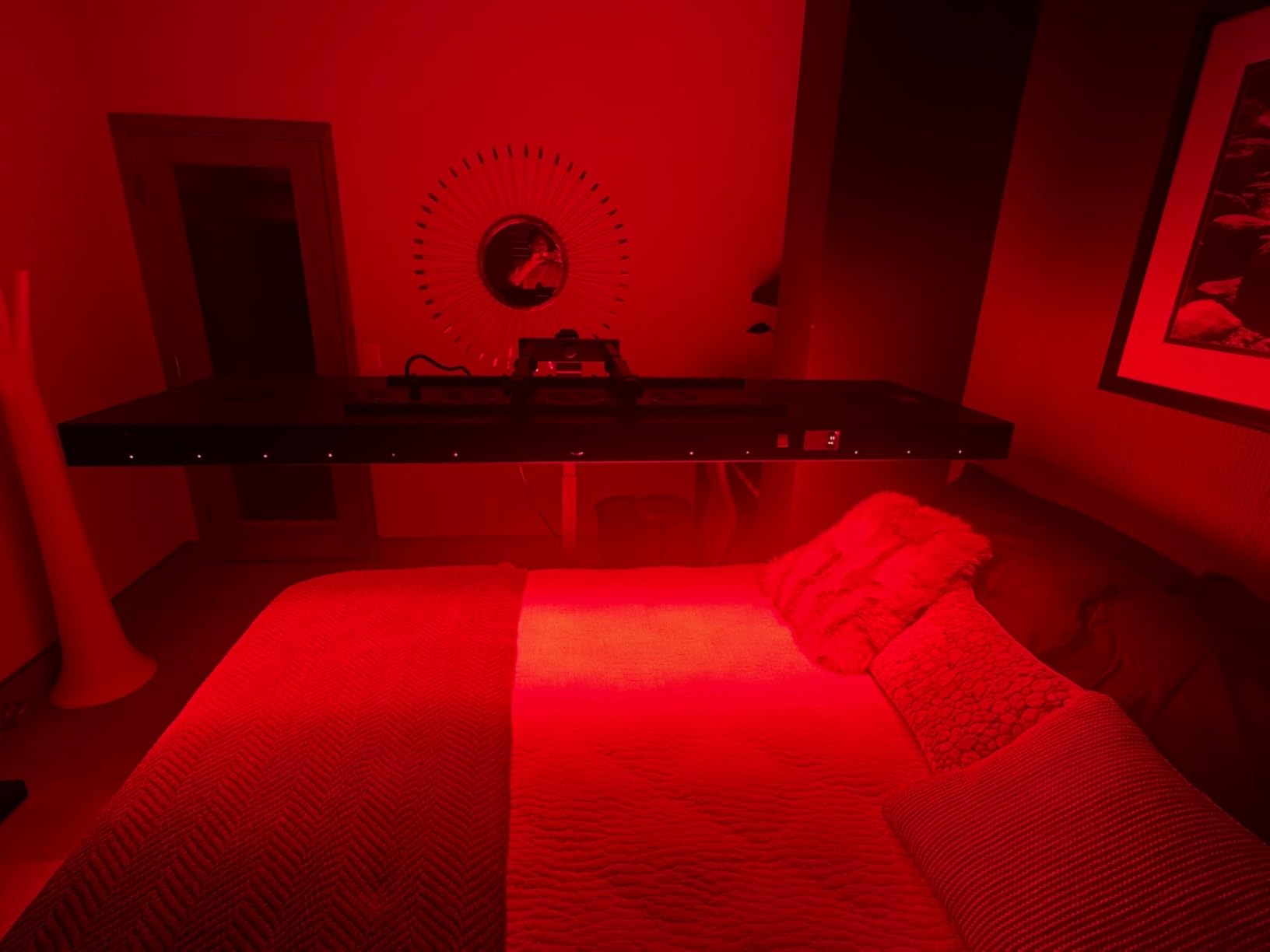
The remote handles everything without touching the panel. You get:
- Separate RED and NIR channel controls — turn each on independently or together
- Timer settable between 1 and 30 minutes with automatic shutoff
- LCD display showing remaining session time
The independent channel control is something I look for in every panel I evaluate. Running red-only for skin-focused sessions and NIR-only for deeper tissue recovery on the same device is a meaningful feature. Panels that only offer combined mode are less flexible.
Real Home Setups
People are actually using this thing, and the user photos tell a more honest story than the product renders.
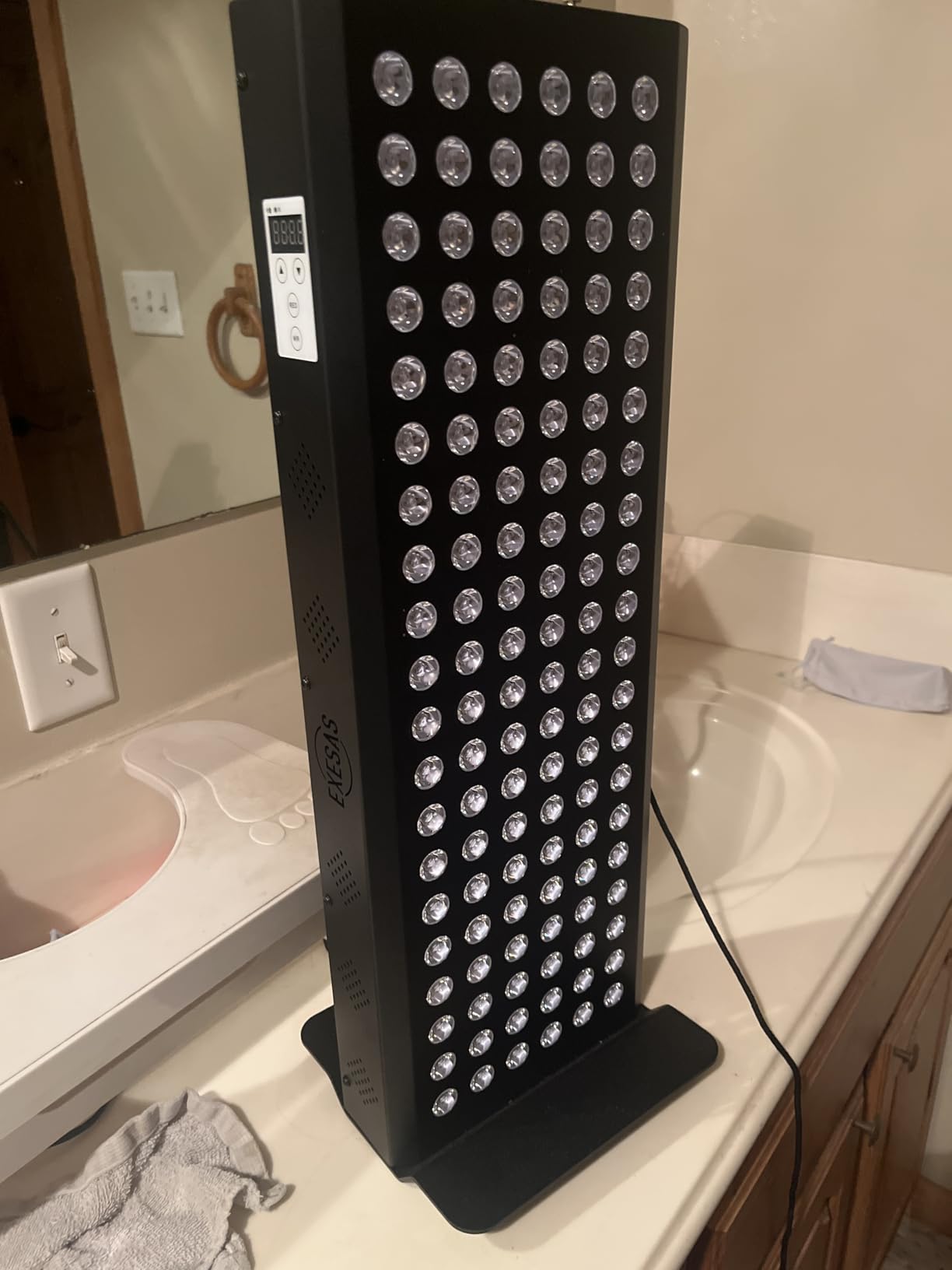
The bedroom shot — panel mounted above the bed, illuminating the mattress — shows someone using the optional horizontal stand configuration. EXESAS sells a heavy-duty horizontal stand separately that lets you mount the panel overhead for lying-down sessions. That’s a genuinely different use case than standing in front of a panel, and relevant for people doing longer recovery sessions where standing for 15-20 minutes isn’t comfortable.
Benefits EXESAS Targets
The panel targets six application areas: skin health, pain management, sleep improvement, energy, weight management, and general wellness.
I’ll be direct about this: the research base across these applications varies considerably in quality and strength.
Skin and wound healing — well-supported. Multiple controlled studies show red light at 630-660nm promotes collagen synthesis and can improve skin texture over time.
Pain and inflammation — reasonably well-supported, especially for joint and muscle applications with 810-850nm. Several clinical trials show positive effects for localized chronic pain.
Sleep — the mechanism is real (NIR can influence circadian rhythms and melatonin timing), though the evidence is less robust than for skin and pain.
Weight management and “energizing” — these are softer claims. Photobiomodulation influences mitochondrial function and cellular energy production, but treating that as a weight-loss tool is a significant extrapolation from the mechanism.
Use this panel for skin work and pain management — the evidence is there. Be more skeptical about the broader wellness claims.
What’s Actually Included in the Box
This is worth specifying because it affects the real total cost:
- Panel unit
- Base stand (freestanding, included)
- Remote control
- Power cord
The base stand being included is a genuine value add. Competitors like BestQool and Hooga sell stands separately at $80-150. At $529 with stand included vs $764 without stand, the price gap narrows considerably when you factor in equivalent setups.
EXESAS vs BestQool Pro300 vs Hooga ULTRA1500
Here’s how the three panels I’ve reviewed in this series compare head-to-head:
| Feature | EXESAS | BestQool Pro300 | Hooga ULTRA1500 |
|---|---|---|---|
| Price | $529 | $764 | $1,399 |
| LEDs | 200 dual-chip | 300 dual-chip | 300 quad-chip |
| Wavelengths | 630/660/810/850nm | 630/660/850/940nm | 630/660/810/850nm |
| Actual Power | 377W | 500W | ~300W |
| Irradiance @3” | 194 mW/cm² | 106 mW/cm² | 190 mW/cm² |
| Irradiance @6” | 134 mW/cm² | similar | 165 mW/cm² |
| Beam Angle | 30 degrees | 30 degrees | 60 degrees |
| Weight | 16 lbs | 19 lbs | 28 lbs |
| Stand Included | Yes | No | No |
| Modular | No | Yes | Yes |
The irradiance comparison is the headline story here. EXESAS at $529 delivers 194 mW/cm² at 3 inches. The Hooga ULTRA1500 at $1,399 delivers 190 mW/cm². Those are essentially equivalent at close distance.
The Hooga wins on beam angle (60 degrees spreads light better at distance), modular expansion, and the quad-chip LED sophistication. The BestQool Pro300 wins on total LED count, 940nm deep penetration wavelength, and expandability.
EXESAS wins on price-per-mW/cm², weight, and stand included.
Who Should Buy the EXESAS Panel
Strong fit if:
- Budget is $500-600 range and you want serious irradiance output
- You’ll primarily use it at close range (3-6 inches)
- You want a standalone setup without buying accessories separately
- The horizontal stand option (overhead lying sessions) appeals to you
- Weight matters — 16 lbs is noticeably easier to handle than 28 lbs
Consider alternatives if:
- You want full-body modular expansion (EXESAS doesn’t mention modular support)
- You need wide-angle coverage at 12+ inch distance (30-degree beam spreads less)
- 940nm deep tissue coverage is a priority (BestQool has it, EXESAS doesn’t)
- You want the proven track record and customer support of established brands like Hooga
One Thing to Know About the 224 mW/cm² Claim
The “greater than 224 mW/cm²” is measured at surface contact — essentially touching the panel. That’s not a practical use distance; you don’t press your skin against a 377W LED panel.
At 3 inches the number is 194 mW/cm², and at 6 inches it drops to 134 mW/cm². Those are the numbers you should actually compare. Both are strong for this price range, but the headline surface contact figure is marketing framing more than operational spec.
This isn’t unique to EXESAS — many brands measure irradiance at their most favorable distance. What matters is that EXESAS provides the distance-calibrated measurements (3”, 6”, 9”, 12”) which lets you make accurate comparisons. Brands that only list a single irradiance number without specifying distance are the ones to be skeptical of.
Final Verdict
The EXESAS panel is a genuinely competitive option for $529 with stand included. The irradiance output is real — 194 mW/cm² at 3 inches is legitimate high-output performance for this price class. The 377W actual power consumption is verified. The independent channel control and timer-based remote are well-executed.
The 30-degree beam angle means you get the most from it at closer distances. The lack of a modular expansion system means this is a standalone purchase, not part of a future full-body setup. And the brand is newer with fewer public reviews than Hooga or BestQool.
But if you’re looking for maximum irradiance per dollar spent and a complete out-of-box setup that doesn’t require extra accessories, EXESAS is harder to dismiss than most panels at this price.
Check current EXESAS price and availability on Amazon
Disclosure: This post may contain affiliate links. Purchases through these links may generate a commission at no extra cost to you.
This content is informational only and does not constitute medical advice. Consult a healthcare provider before beginning any new wellness protocol. These statements have not been evaluated by the FDA.