Not a doctor. Not a PT. Just a guy who lives in a van, works Forest Service contracts, and has spent a decade hauling lumber and dragging fire hose in ways that have made my shoulder a reliable weather forecaster. That’s the context for everything that follows.
I bought the BONTANNY BO-2400 in December for muscle recovery and joint discomfort. Five months in, I have opinions. I’m not going to make medical claims — the FDA hasn’t approved red light therapy for specific conditions, and any review promising health outcomes is selling you something. What I can tell you is how this device performs as a product, what I’ve noticed using it, and whether it makes any sense in a small mobile space.
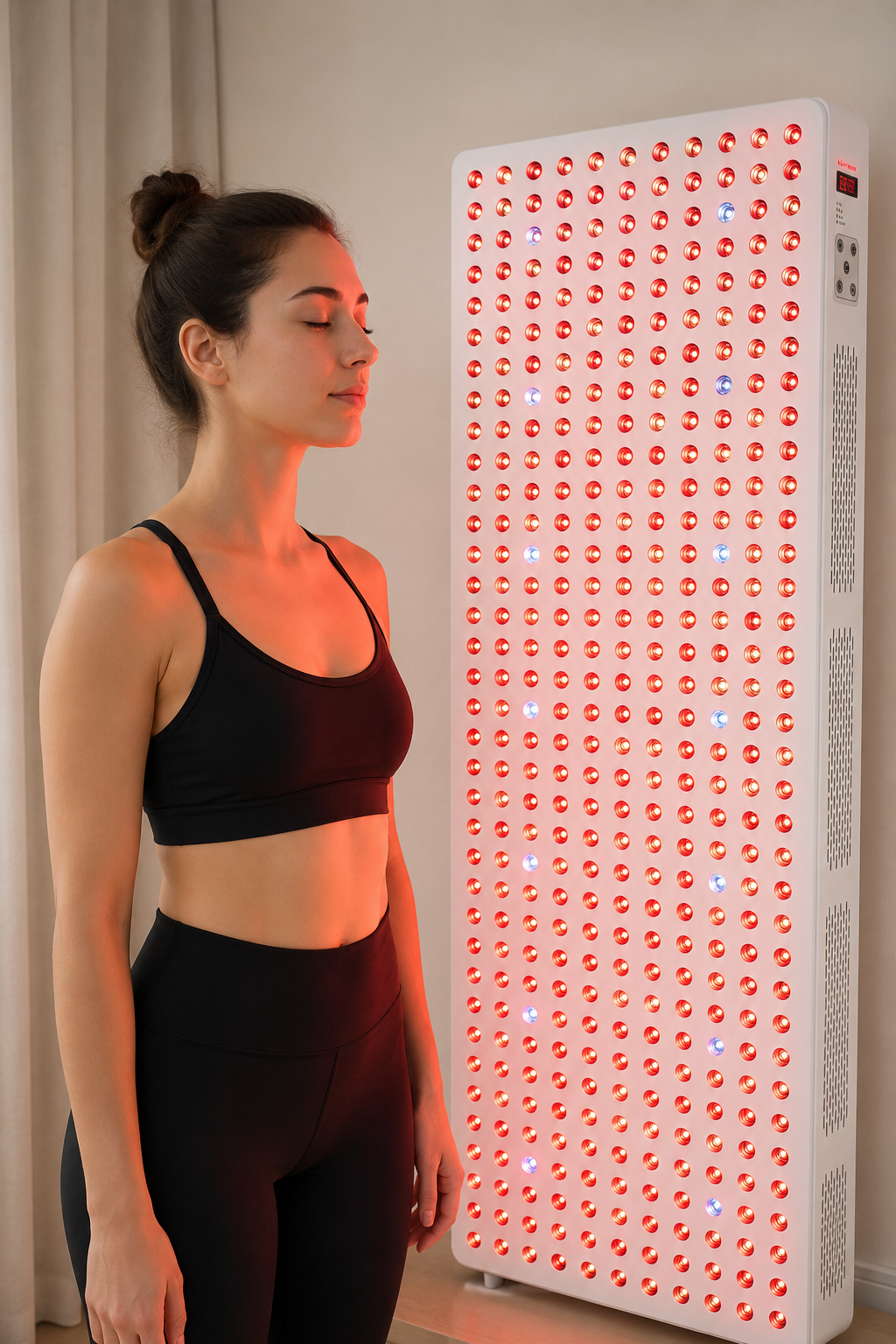
Table of Contents
Open Table of Contents
- Why I Bought a Full-Body Red Light Panel for a Van
- What’s Actually in the Box
- The Seven Wavelengths Explained Without Marketing Speak
- Real-World Setup in a Van
- The 130mW/cm² Irradiance Claim
- My Subjective Experience After 5 Months
- The Cooling Fan: Quieter Than Expected
- Comparison: Where the BO-2400 Sits in the Market
- What Annoys Me
- Setup Tips Worth Knowing
- Who Should and Shouldn’t Buy This
- Long-Term Durability After 5 Months
- A Few Things People Actually Ask
- External Resources
- See Today’s Deal on Amazon
Why I Bought a Full-Body Red Light Panel for a Van
Four years full-time in vans. Started in a Promaster, currently a Sprinter 144. Years of physical work plus van sleeping equals chronic shoulder stiffness, lower back tightness, and an old knee injury from a 2008 skateboarding incident that ended my casual relationship with concrete.
I’ve worked through the standard recovery toolkit. Foam rollers (which I roll over in bed and then can’t sleep). Massage guns (loud electronics in a vibrating van don’t coexist well). Heating pads (great until the inverter dies). Topical creams (smell like a hockey locker room).
I’d been hearing about red light therapy from physical therapist friends and various podcasts I half-listen to while driving. The basic concept — specific wavelengths of red and near-infrared light penetrating skin and tissue — has actual peer-reviewed research behind it for certain applications. The science is real, even if wellness marketing has stretched it past what the research actually supports.
My skepticism was whether a consumer device could deliver enough irradiance to produce any meaningful effect, given that clinical studies mostly use devices that cost five figures. The BO-2400 claims 130mW/cm² at 6 inches, which is at least in the range some research uses as an effective dose threshold. Whether the marketing claim holds up is another question — I’ll get to that.
I paid $899 in December. Pricing fluctuates. Current Amazon listing: BONTANNY BO-2400 on Amazon
(Affiliate link. Small commission if you buy through it. Bought my own unit. Full disclosure at the bottom.)
What’s Actually in the Box
Heavier than I expected. The panel itself, a 1.8m power cord, a remote control (requires a 23A 12V battery that is NOT included — first annoyance), eye protection goggles, a hanging kit, a basic user manual, and a microfiber cleaning cloth.
The panel is roughly 49.9 inches tall by 16.2 inches wide, sized for full-body coverage when standing about 6 feet away. In a van, that’s a large object. More on this later.
Build quality is decent. Aluminum frame with reinforced corners. The LED face is covered in clear protective panels. The back has the cooling fan assembly, power input, and control board. Hanging brackets are real metal, not the plastic stuff cheaper panels ship with.
Control interface is simple — three buttons on the panel side plus the remote. Three independently controllable modes: Red only (630/660nm), Infrared only (810/830/850nm plus 1060nm), and Combined (all wavelengths plus 480nm blue). Each mode has a 10-30 minute timer in 10-minute increments. No app, no Wi-Fi, no Bluetooth. For a van that lives through vibration and temperature swings, fewer things to break is a feature.
The Seven Wavelengths Explained Without Marketing Speak
The BO-2400 emits 480nm (blue), 630nm (red), 660nm (red), 810nm (near-infrared), 830nm (near-infrared), 850nm (near-infrared), and 1060nm (far-red/NIR). Marketing treats more wavelengths as automatically better, which is sort of true but needs unpacking.
Different wavelengths penetrate to different depths and have been studied for different applications. The rough breakdown:
480nm blue is the most superficial. Research focuses on effects at the upper layers of skin. Some panels skip it entirely.
630/660nm red penetrates to roughly dermis depth. The 660nm wavelength is the workhorse of most red light therapy research.
810/830/850nm near-infrared penetrates significantly deeper than visible red. The 850nm is the standard NIR workhorse in research literature.
1060nm sits at the edge of what consumer panels typically include. Some research suggests deeper penetration than 850nm, but the evidence base is smaller.
Seven wavelengths means surface and deep coverage in one panel. Whether that’s worth the price premium over a simpler 2-wavelength panel depends on what you’re after. For someone wanting both general wellness and deeper muscle recovery, the broad spectrum makes sense. For skin-only applications, a simpler panel would do.
Real-World Setup in a Van
This is where most reviews fail you — they’re written by people with a spare bedroom. Here’s what setting up a 49.9-inch, 24-pound panel in a Sprinter conversion actually looks like.
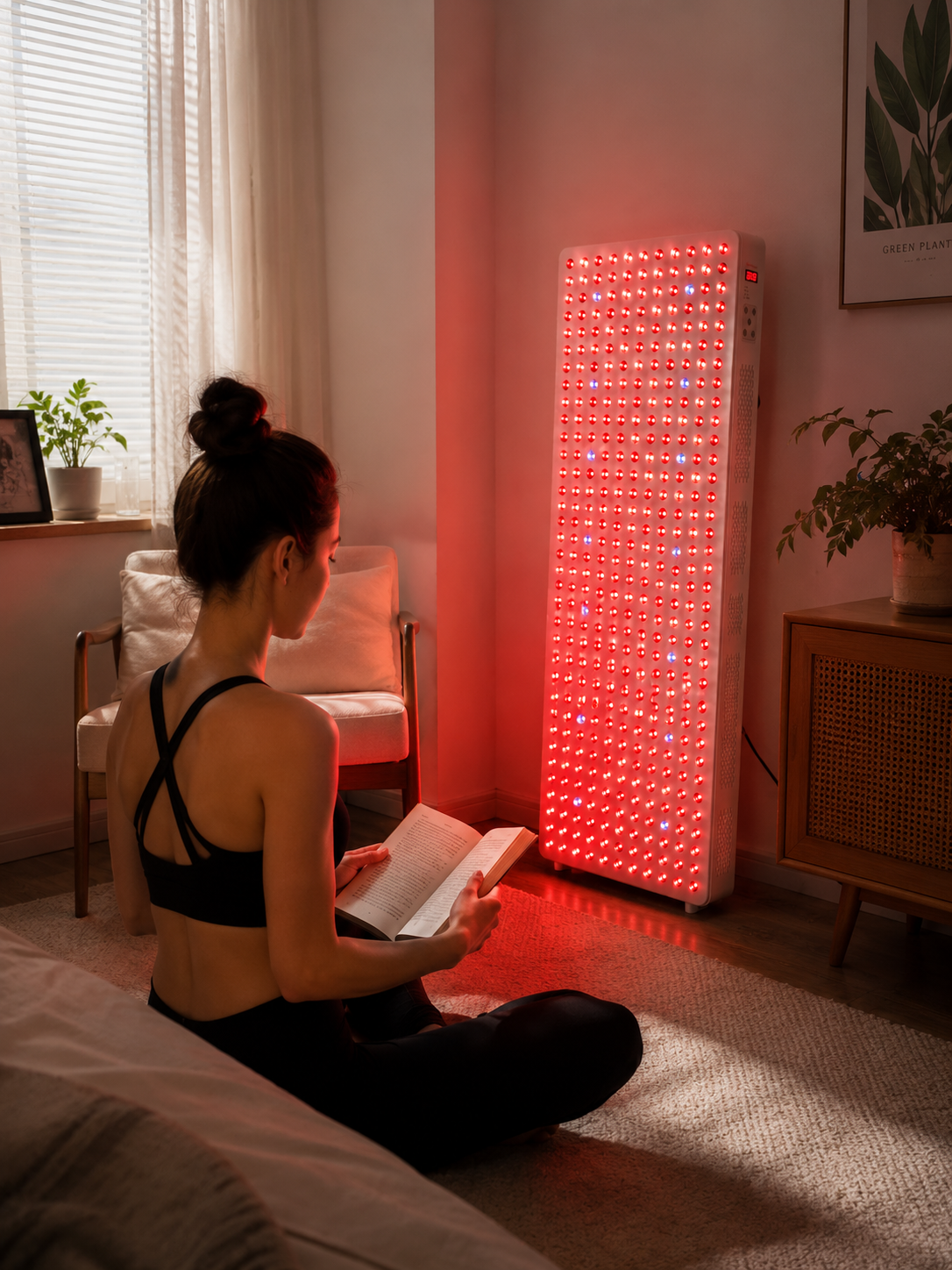
The panel needs a vertical mounting solution, a clear 6-foot floor area in front of it, a power source (about 200W in combined mode, noticeable on a 100Ah battery over a 20-minute session), and eye protection that stays on while you’re standing.
My solution: I mounted the panel on the inside of the rear barn doors using custom L-brackets bolted through the door frame. When I want a session, I open the doors all the way out, which puts the panel facing into the van interior. I stand in the cabin facing the open rear, do my session, then close up. About 90 seconds to set up, 60 seconds to break down.
This only works when there’s enough space behind the van to open the barn doors fully. Forest Service dispersed sites, friends’ driveways, BLM land — fine. Tight parking lots, urban street parking, campground sites with neighbors close behind — not so much. Plan your spots accordingly.
The 130mW/cm² Irradiance Claim
Irradiance is the actual light energy hitting a surface per unit area, measured in mW/cm². The threshold for clinically meaningful red light therapy in most research is around 30-100 mW/cm² depending on the application. BONTANNY’s 130 mW/cm² claim at 6 inches puts the BO-2400 in the upper range of consumer panels.
I don’t have calibrated lab equipment. Most reviewers who claim they do are using the same $40 budget light meters I have. Mine measured roughly 110-120 mW/cm² at 6 inches — lower than the claimed 130 but within the error range of a cheap meter. Honest reviewers measuring other premium panels report similar gaps between claimed and measured numbers.
What this means practically: the BO-2400 delivers enough intensity to produce therapeutic doses in reasonable session times. It’s not the most powerful panel on the market — the EMR-TEK Firestorm Pro hits higher numbers at a higher price — but it’s in the range where the research suggests effects are possible. That was my minimum bar.
My Subjective Experience After 5 Months
I want to be careful here. Personal observation is not clinical evidence, and I’m not a doctor. Here’s what I noticed, nothing more:
Shoulder stiffness: I’ve been doing 15-minute combined-mode sessions about 5 days a week, panel about 8 inches from my upper body. Over the first 6-8 weeks, morning shoulder stiffness gradually improved. Whether that’s the light, the fact that I’m now standing still for 15 minutes instead of rushing, or just natural variation — I can’t say. But the improvement has held over 5 months, which makes pure coincidence harder to argue.
Skin: My partner pointed out my face looks different after a month of consistent use. Less weathered. I don’t monitor my own skin quality, but multiple people mentioned it unprompted, which I found harder to dismiss than if I’d noticed it myself.
Sleep: Marginal improvement on evenings when I do a session. Could be placebo. Hard to separate from everything else that affects sleep in a van.
Old knee injury: No change. The injury is structural, not inflammatory, so this isn’t surprising.
Energy levels: Nothing I could attribute to the panel. Some good weeks, but those correlated more with sleep and weather than with sessions.
These are observations, not claims. Your experience will vary. Red light therapy research shows real effects in controlled studies, but those effects are smaller and slower than wellness marketing suggests.
The Cooling Fan: Quieter Than Expected
The rear fans run whenever the unit is on. I’d read complaints about fan noise in other panels and was ready to be annoyed. In practice, they run around 45-50 dB at a foot away — quieter than my diesel heater, quieter than a bathroom exhaust fan. They speed up during longer sessions as the LEDs heat up, but even at max they don’t compete with a conversation.
Comparison: Where the BO-2400 Sits in the Market
| Panel | Approx Price | Irradiance (claimed) | Wavelengths | LEDs |
|---|---|---|---|---|
| BONTANNY BO-2400 | $700-900 | 130 mW/cm² | 7 | 480 |
| Hooga HG500 | $400-500 | 100 mW/cm² | 2 (660/850nm) | 100 |
| Mito Light Mobile 3.0 | $500-600 | 110 mW/cm² | 4 | 60 |
| EMR-TEK Firestorm Pro | $1,300+ | 200+ mW/cm² | 4-5 | 480 |
| Joovv Solo 3.0 | $1,400+ | 100 mW/cm² | 2 (660/850nm) | 300 |
| PlatinumLED BIOMAX 900 | $1,000-1,200 | 154 mW/cm² | 5 | 200 |
The BO-2400 sits in the upper-mid market. More wavelengths than most, similar irradiance to comparable panels, significantly cheaper than Joovv and EMR-TEK. The 660/850nm combo has the most research backing of any wavelength pairing. If that’s all you care about, you can save money with a simpler panel. If you want broader spectrum coverage and the price gap doesn’t hurt, the BONTANNY makes sense.
What Annoys Me
The remote battery isn’t included. A 23A 12V battery isn’t in anyone’s battery drawer. At $899, include the battery.
The eye goggles are mediocre. Flimsy, don’t seal well at the edges, uncomfortable elastic after 5 minutes. I replaced them with aftermarket red-light-specific goggles within the first week. Budget $25 for this.
The hanging kit assumes drywall. Nothing in it is useful for wood paneling, metal van walls, or anything other than standard residential construction.
No carrying solution. If you ever move this thing — and you will — you’re carrying it bare or wrapped in a blanket.
The manual is thin. Setup and safety are covered. Optimal distances for different goals, session frequency, how to combine the modes — not covered. You’re on your own researching protocols.
Timer increments are 10 minutes only. I often want 20-25 minute sessions. The options are 10, 20, or 30. Five-minute increments would cost nothing to implement.
Setup Tips Worth Knowing
Spend an hour on Google Scholar before your first session. Search “photobiomodulation” — that’s the academic term, and it cuts through the marketing noise. Different goals have meaningfully different optimal protocols.
Always wear eye protection. The infrared intensity is high enough to cause retinal damage with extended bare-eye exposure. Goggles every time, no exceptions.
Start at 10 minutes for the first week. Some people get mild headaches or fatigue with longer initial sessions. Build up from there.
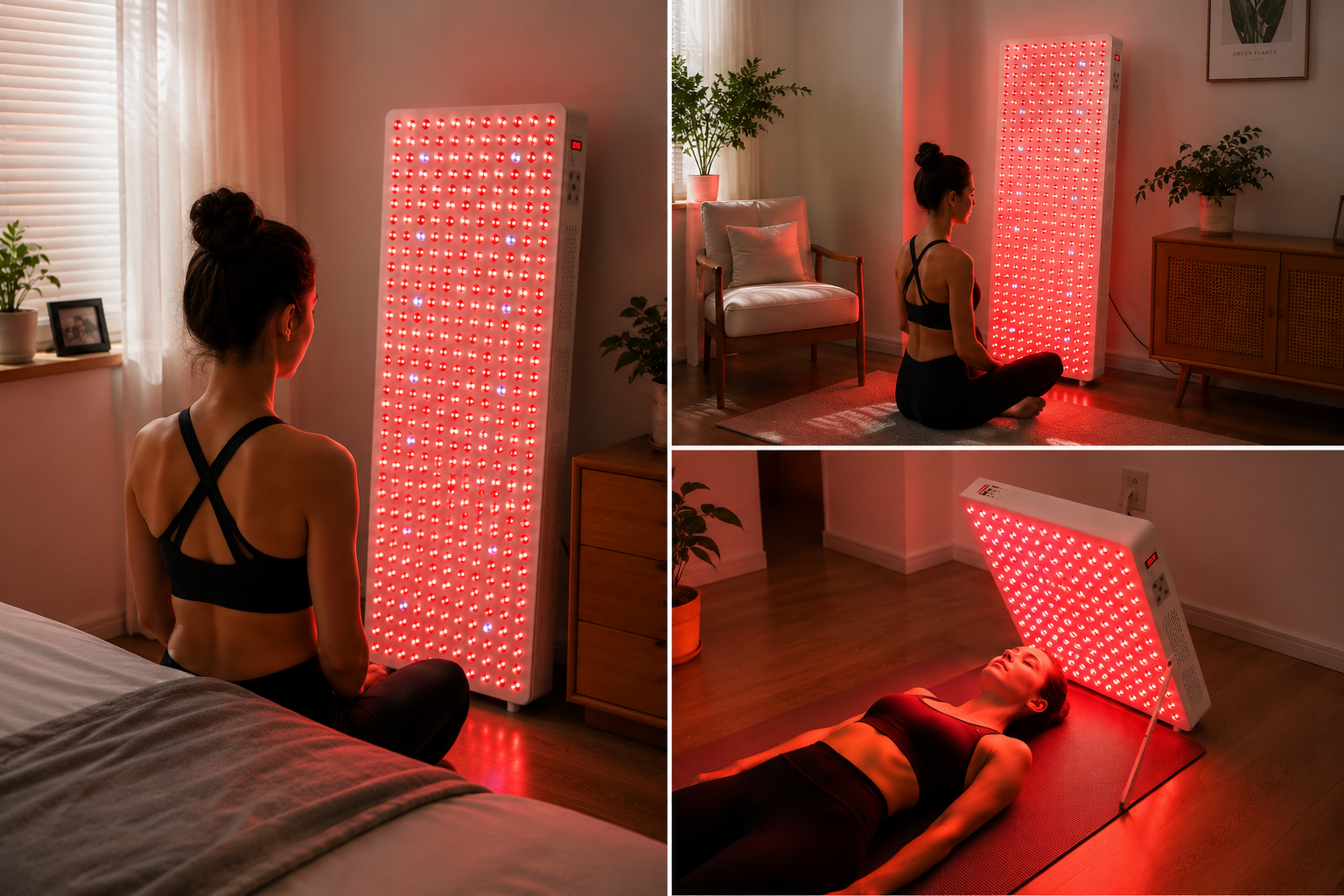
Keep skin 4-12 inches from the panel. Closer means higher intensity, smaller treatment area. Six to eight inches is the sweet spot for most uses.
Skin has to be exposed. Light doesn’t penetrate clothing. Plan your privacy if you’re in a shared space.
Don’t expect anything in the first two weeks. Most research shows effects building over 4-8 weeks of consistent use.
Who Should and Shouldn’t Buy This
People with chronic muscle and joint discomfort from physical work — this is my situation, and it’s been worth it. Real improvement in daily baseline comfort, even if modest.
Athletes doing post-exercise recovery — research support here is reasonably solid. Legitimate addition to a recovery toolkit, not a replacement for sleep and nutrition.
People with specific skin concerns — stronger research support exists here than for most other applications.
Van lifers and small-space dwellers — only if you have a real mounting plan and the floor space. In a Promaster or Transit Connect, you probably don’t. In a Sprinter or larger with rear barn doors, it’s workable with some creativity.
Anyone expecting dramatic fast results — don’t buy this. Effects are real but modest and slow. That’s what the research says, not a caveat I’m adding to hedge.
DIYers — you can build a comparable panel from individual LEDs for less than half the price. Less polished, fully functional. Worth considering if you have patience.
Long-Term Durability After 5 Months
All 480 LEDs are still functional. I’ve counted (yes, I’m that person). LED failure is the most common long-term problem with light panels — once 5-10% of diodes die, irradiance drops noticeably — so I check periodically.
Cooling fans still run smoothly, no bearing noise. Control buttons feel the same as day one. The aluminum frame has scuffs from van travel, nothing structural. I’ve dropped the panel once getting it off the barn door mounts. It survived.
The power cord shows no wear at the strain reliefs. Clear protective face panels show no scratches or yellowing after regular cleaning.
BONTANNY is a relatively new brand, so the 18-month and 3-year durability question is genuinely unknown. The Mito Light has reported LED failures around 18 months in some user threads. The Hooga has had cooling fan issues. The Joovv has held up well. I’ll update this at 12 months if there’s anything to report.
A Few Things People Actually Ask
Is it FDA-approved? Not FDA-cleared as a medical device. Marketed as a wellness device. Some BONTANNY products in their lineup are FDA-registered, which is different from cleared. If FDA clearance matters for your specific use case, verify the current status before buying.
What about the “zero EMF” claim? “Zero EMF” in marketing language means measurements at the recommended treatment distance, not at the panel surface. At 6+ inches, the BO-2400 measures near background EMF levels. At the surface, all electronics produce some EMF. Whether this matters to you is your call.
How long should sessions be? Most research protocols use 10-20 minutes. The BO-2400 goes up to 30. For general use, 15 minutes is a reasonable default. More isn’t always better — there’s research suggesting excessive doses can reduce effectiveness.
Can I leave it in the van during temperature extremes? I cover mine with a moving blanket during summer heat and bring it inside on overnight freezes. No issues so far. LEDs don’t love sustained temps above 100°F. Below freezing probably won’t damage it but might cause sluggish startup.
What’s the warranty? Amazon listings show 1 year. Direct purchases from BONTANNY may differ. Verify before buying — warranty terms change.
Can I use it with sunscreen or skin care products on? Don’t. Sunscreens reflect and absorb some of the light. Skin care actives can react unpredictably with concentrated light exposure. Apply anything after sessions, not before.
External Resources
For actual research, search Google Scholar for “photobiomodulation” rather than “red light therapy” — the academic term returns cleaner results than the marketing-heavy consumer searches. The r/RedLightTherapy subreddit has real user discussion about protocols and panel comparisons. Apply normal skepticism to wellness influencer takes, even credentialed ones.
Five months, roughly 120 sessions. The shoulder is better. The skin thing I didn’t ask for turned out to be a bonus. The knee hasn’t changed, which I expected. The panel is bulky and the mounting solution took some figuring out, and I’m genuinely uncertain whether some of what I’ve noticed is the light or just the effect of standing still for 15 minutes a day.
What I can say is I’m still using it daily, which is more than I can say for the massage gun gathering vibration damage under my bed.
See Today’s Deal on Amazon
Affiliate Disclosure: This post contains Amazon Associates links. If you purchase through these links I earn a small commission at no additional cost to you. I bought my own BO-2400 before joining the program. Opinions are based on 5 months of daily use and are not influenced by commission incentives.
Health note: This is personal experience with a consumer wellness device, not medical advice. I’m not a healthcare professional. Red light therapy has research support for some applications and not others. If you have a specific medical condition, talk to a doctor before adding any wellness device to your routine. This panel is not a treatment for anything. Specs and pricing change — verify before purchasing.