The last red light panel I bought died on a Tuesday in January. Mid-session. A flicker, a tiny pop like someone stepping on a lightbulb in the next room, and then me standing there in my underwear in front of 200 dead LEDs, glowing only from embarrassment. It was a cheap unit. I knew it was cheap when I bought it. I bought it anyway, because I am the kind of person who learns lessons the expensive way, twice.
So when the Hooga ULTRA1500 showed up at my door, I was not in a generous mood. I was in a “prove it” mood. I’d already been through the Exesas 200 LED panel phase, the “maybe mid-range is fine” phase, the whole ladder. This thing costs real money — list price is $1,399 on Hooga’s site, though it floats closer to $849 on Amazon depending on the day and the coupon gods — and I fully intended to hate it and send it back within the 60-day trial.
I’m writing this three months later. It’s still hanging on my door. Make of that what you will.
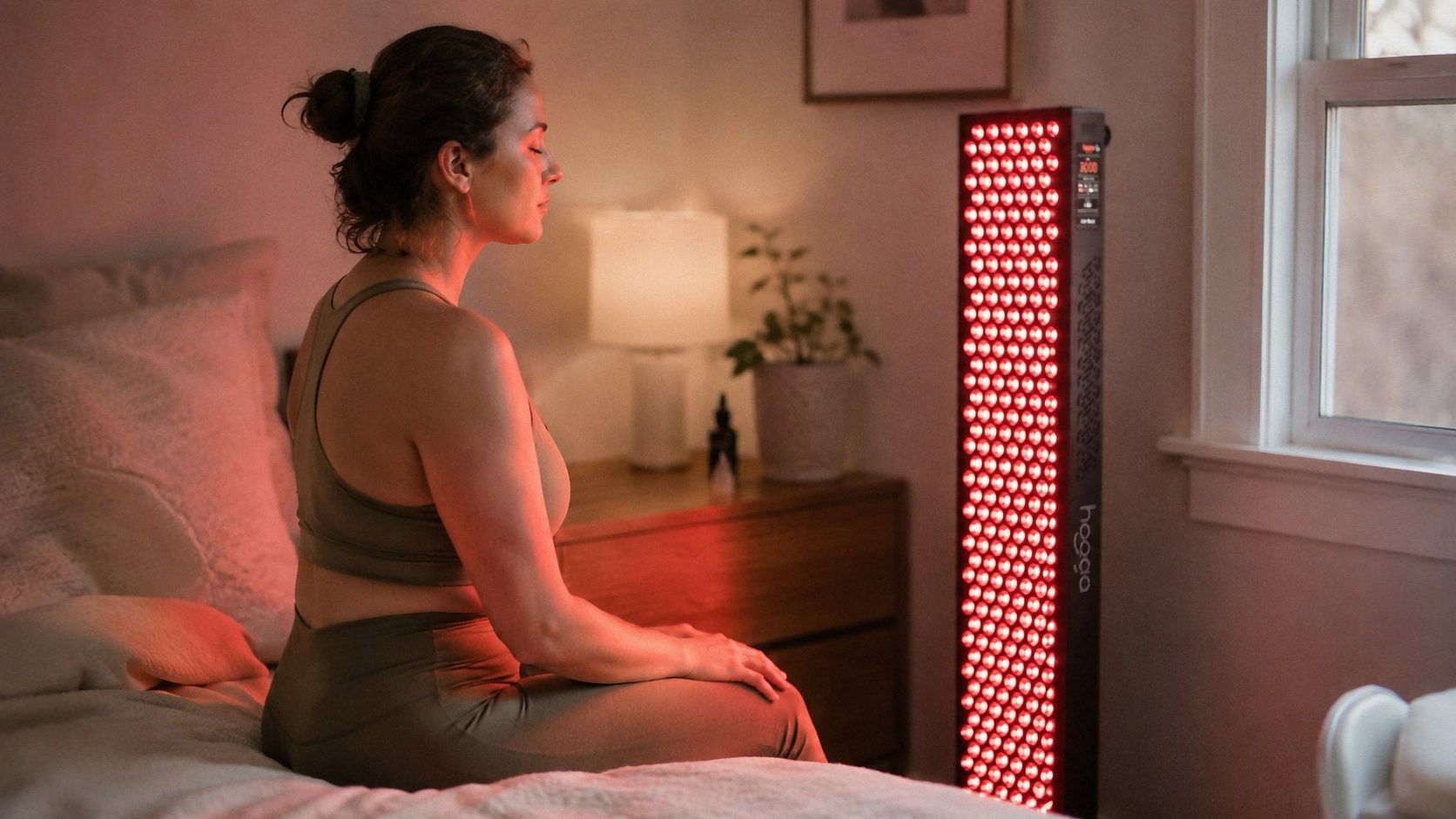
The Box, the Door, and My Lower Back
First, a warning that nobody gives you: this panel weighs 28 pounds. That doesn’t sound like much until you’re holding it at chest height with one hand while trying to hook a door mount with the other, and your lower back files a formal complaint. The box it ships in is roughly the size of a small coffin for a very tall cat. I dragged it up the stairs myself because my neighbor watched me struggle and clearly decided it was entertainment.
The dimensions are 39.5 by 8.6 by 2.5 inches, which means it covers from my neck to my knees when I stand in front of it. That’s the entire point of a full-body panel, and it’s the thing the little ones physically cannot do no matter how good they are. I tested the Hooga Pro300 before this — decent little panel, same family, same wavelengths — but treating your whole torso with a Pro300 is like painting a fence with a toothbrush. You move it every three minutes. You do math. You give up on your lower half entirely and tell yourself calves don’t matter.
In the box: the panel, a US 3-prong power cord, a hanging kit with an adjustable pulley, a door mount, protective goggles, and a manual that reads like it was translated by someone who learned English from airline safety cards. The pulley is genuinely useful, by the way. You clip the panel on and hoist it like a flag, then tie off the cord. Mine squeaks. A tiny, specific squeak, right at the top of the travel. I’ve come to find it charming, which tells you how far gone I am.
What the Numbers Actually Feel Like
Here’s the spec dump, translated into human: 300 quad-chip LEDs, each one firing four wavelengths — 630nm and 660nm red, 810nm and 850nm near-infrared. Irradiance is over 165 mW/cm² at 6 inches, which is a big number. Most panels in the budget tier claim numbers like that and deliver them only if you press your skin directly against the diodes and believe in magic. The ULTRA1500 actually feels like it. At six inches there’s a real, dense warmth on your skin within a minute. Not heat-lamp heat. More like standing in sun through a window, except the window is a foot wide and follows no weather.
Sessions are short. Hooga says 2 to 15 minutes at 6 to 18 inches, and the first time I did a cocky 20 minutes at 8 inches because “more is more,” my skin felt sun-tight for an hour afterward. Lesson absorbed. I now do 10 minutes at about 10 inches, front and back, most days. My creaky right knee — the one that predicts rain — has gone from filing daily reports to occasional memos. My sleep got heavier within two weeks, which I did not expect and initially attributed to the winter, the new pillow, anything but the giant red glowing monolith. It was the monolith.
I want to be careful here, because this is where review sites turn into infomercials. Red light therapy has actual research behind it — thousands of studies on collagen, inflammation, muscle recovery — and it also has a cloud of wellness-bro hype thick enough to choke on. My rule: I report what happened to me, I don’t promise you anything. Knee better. Sleep heavier. The patch of angry skin on my elbow calmed down. Your mileage will vary, and anyone who guarantees otherwise is selling something. I mean, I’m technically selling something too — if you grab one through the links here, I might get a small cut — costs you nothing extra and keeps the lights on. But I’d rather you buy it with clear eyes than starry ones.
The Four-Wavelength Thing, and Why I Stopped Rolling My Eyes at It See Today’s Deal on Amazon
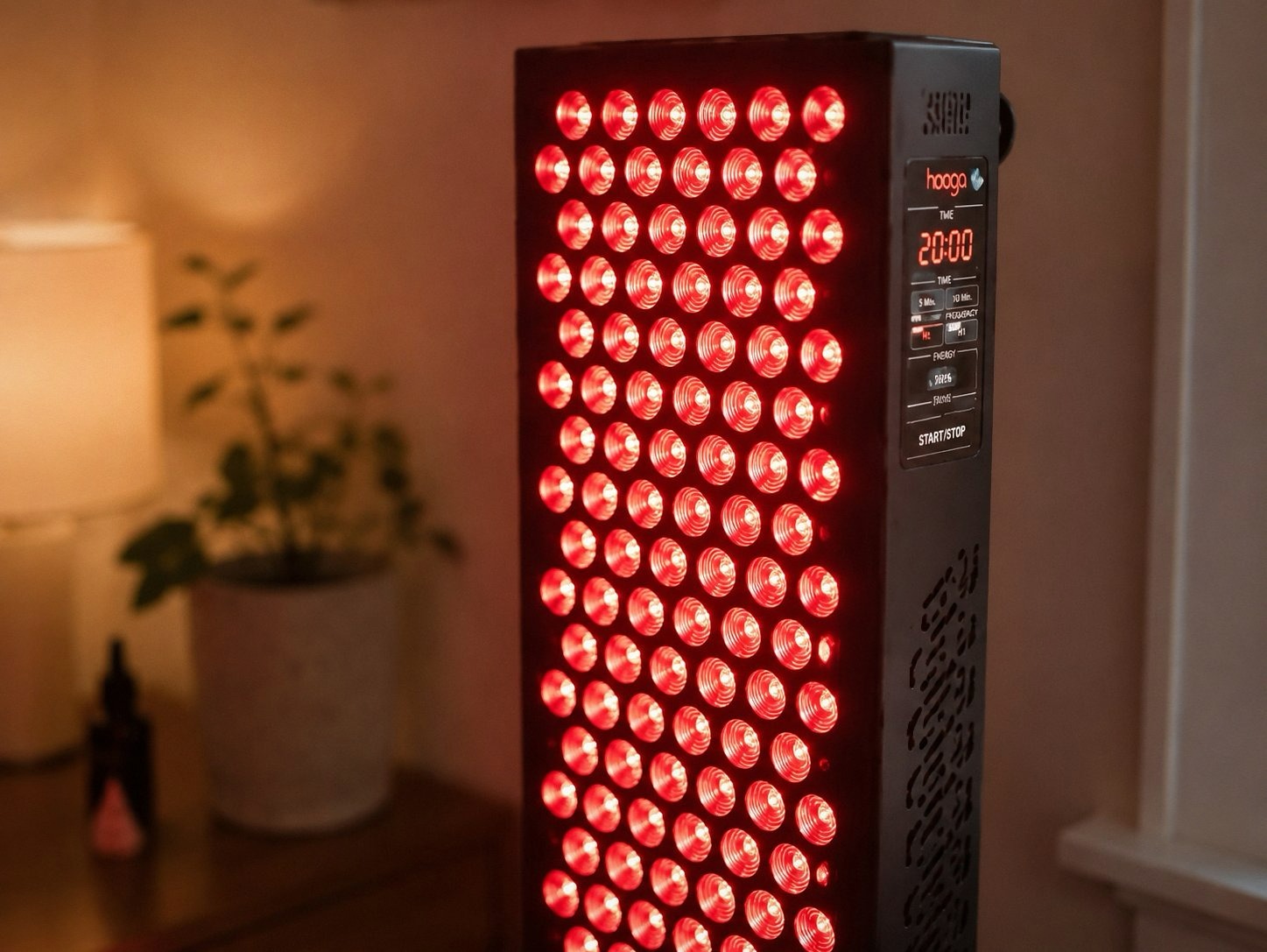
I used to think multi-wavelength marketing was mostly numerology. Then I spent time with the Bontanny BO-2400, which crams in seven wavelengths, and came away thinking that at some point you’re just adding numbers to the box. Hooga’s four feel like the version where someone stopped at “enough.” The two reds handle skin-level stuff — tone, fine lines, the general “did you sleep?” question people ask you. The two near-infrareds go deeper, into muscle and joint territory, and here’s the owner detail nobody tells you: near-infrared is invisible. The panel can be blasting 810 and 850nm at full power and it looks almost off, just a faint deep-red ember glow from the diodes. The touchscreen shows which channel is live, thankfully. More than once in the first week I waved my hand in front of it like an idiot, checking.
You can run red only, NIR only, or both, each with its own brightness slider from 1% to 100%. Evening sessions I drop red to 40% so the bathroom doesn’t look like a darkroom crime scene. This level of pickiness is something I mocked in the Bestqool Pro300 review — “who needs granular brightness, just turn it on” — and I now formally eat those words, because at 6 a.m., half asleep, 100% red light to the face is an act of violence.
Pulse Mode, the Feature I Didn’t Use for a Month
The ULTRA1500 pulses anywhere from 1Hz to 9999Hz. There’s a body of thought that pulsed light does different things to tissue than continuous wave, and there’s a body of thought that says it’s mostly a checkbox on a spec sheet. I am not a scientist. I set it to 10Hz for knee days because some study I half-read said 10Hz, and I cannot tell you if the pulse or the light or the placebo is doing the work. What I can tell you is the setting exists, it’s easy to change, and at low frequencies you can see the flicker in your peripheral vision, which is either stimulating your cells or simulating a busted fluorescent tube. Choose your adventure.
The Touchscreen, the Fans, and Other Roommates
The control panel is a touchscreen with sliders. It beeps. Every press, a chirpy little beep, loud enough to wake a light sleeper in the next room, and I dug through the settings twice and never found a way to mute it. At 6 a.m. that beep is the rudest sound in my home. I’ve started pressing the buttons with the pad of my whole thumb, as if pressing gently makes it quieter. It does not. This is not rational behavior. Neither am I, before coffee.
Four cooling fans live inside, and they’re the first thing a visitor asks about. They sound like a decent desktop PC under light load — not silent, not annoying, just present, a low hush that fades into the room after a minute. The detail that sold me on the build quality: when the timer ends, the light cuts instantly but the fans keep running for another 30 seconds or so, dumping the residual heat. That’s a small, unsexy engineering decision that suggests someone at Hooga has actually owned electronics before. My dead January panel went dark with a pop and silence, fans and all, forever. This one finishes its drink before leaving the bar.
The metal casing stays cool on the front edges and gets properly warm along the top vents after 15 minutes at full blast. The goggles they include are — how do I put this — technically goggles. Two rubber cups on an elastic band, smelling faintly of a new shower curtain, that press into your eye sockets like they have a personal grudge. I used them for a week, then bought a $12 pair of blackout tanning goggles and relegated the included pair to the drawer of cables and shame. For the red wavelengths I’ll admit I mostly just close my eyes. Don’t tell Hooga.
The Annoying Bits, Because There Are Always Annoying Bits
Twenty-eight pounds is not a number, it’s a lifestyle. Once this thing is on your door, that door is no longer a door. It’s a shrine. You want to close the bathroom door during your session? Too bad, the panel’s on it. I have scuff marks on the top of my door frame from the mount hook, two grey crescents I’ll have to paint over when I move. Renters, take note. Hooga sells a mobile stand separately, and by “separately” I mean they get another couple hundred dollars out of you because the door solution eventually annoys you into the stand. I’m currently resisting. The scuff marks are winning.
The timer maxes at 30 minutes and beeps at the end — fine — but it doesn’t remember your last settings after a power loss, and we had a breaker trip during a storm that reset everything to defaults. First-world gripe, noted, still a gripe. And there’s no app. Everything is on the touchscreen. Part of me respects that — no account, no firmware update bricking my wall panel at 5:50 a.m., no subscription. Part of me wants to start a session from bed so the thing’s warmed up and beeping is done before I shuffle in. The two parts of me argue. Nobody wins.
Price. Let’s just stand in front of it together: this is a lot of money for what is, materially, 300 LEDs in a metal box with fans. The counterargument is that the cost per session against a $50 clinic visit collapses within two months of daily use, and the 50,000-hour lifespan means you’ll die before it does. The counter-counterargument is that you could buy three Bestqool Pro300s for this money and duct-tape them to a shelving unit. I have seen the duct-tape path. I’ve been on the duct-tape path. It ends with a pop on a Tuesday in January.
Who Should Actually Buy This Thing
Buy it if you’ve already done the cheap-panel dance and know you’ll use it daily, because the math only works if you show up. Buy it if your complaint list includes joints, recovery, sleep, or skin, and you’re tired of treating one knee at a time with a panel the size of a cutting board. Skip it if you’re red-light-curious and not sure — start smaller, borrow one, try the Hooga Pro300 tier first and see if the habit sticks before you commit to the monolith. Skip it, definitely, if your door frames are load-bearing arguments with your landlord.
Three months in, my verdict is uncomfortably positive for a man who unboxed it hoping to return it. The Hooga ULTRA1500 is overbuilt, overbright, and priced like it knows it. It also runs every single day without complaint, cools itself down like a professional, and turned my 10-minute morning session into the most reliable part of my routine. I hate how much I like it. That’s the review.
The tea I made at the start of this has gone cold on the kitchen table, the pulley just squeaked because someone upstairs slammed a door, and my timer beeped four minutes ago — my session’s waiting. The panel doesn’t care whether I show up. It’ll beep either way.
I’m going to go stand in front of it now. The knee’s been quiet for weeks, and I’d like to keep it that way.