If you’ve spent more than ten minutes shopping for a red light therapy panel, you’ve run into the wavelength alphabet soup. 630nm, 660nm, 810nm, 850nm, 940nm. Sometimes 660nm and 850nm only. Sometimes all five. Sometimes weird ones like 590nm or 1064nm thrown in for the high-end stuff.
Here’s what nobody tells you upfront: most of the marketing copy on these wavelengths is technically true and practically useless. “Penetrates deeper for better results” doesn’t tell you anything. Better results for what? Deeper to where? Compared to what?
This guide fixes that. I’ll walk through what each of the five most common wavelengths actually does, how deep each penetrates into tissue, what the research says (and doesn’t say), and which combinations make sense for which goals. By the end you’ll be able to read a panel spec sheet and know whether the wavelength choices match what you’re trying to accomplish.
This is the foundation piece that makes my panel reviews actually useful. If you’ve already read the Hooga ULTRA1500 review or the BestQool Pro300 review and wondered why one uses 810nm and the other uses 940nm, this article is the answer.
The Two-Sentence Version
Red light (630-700nm range) is for things you can see and feel on the skin: surface texture, fine lines, superficial inflammation, wound healing. Near-infrared light (700-1100nm range) is invisible and travels deeper into tissue: muscle recovery, joint pain, deeper inflammation, anything that lives below the skin layer.
Most of the rest of this article is detail on which wavelength within those buckets does what, and why panels mix them.
How Light Penetration Actually Works
Before getting into specific wavelengths, you need to understand the underlying principle. It’s not complicated, but it’s the lens you’ll evaluate every wavelength claim through.
When light hits your skin, three things happen. Some bounces off (reflection). Some gets absorbed by surface tissue (absorption). Some travels through and gets scattered or absorbed deeper (penetration).
Penetration depth is determined primarily by wavelength. Longer wavelengths penetrate deeper than shorter ones, up to about 1100nm where water absorption starts to dominate and depth drops off again.
Here’s the rough penetration ladder for the wavelengths we care about:
| Wavelength | Approximate Penetration Depth | What This Reaches |
|---|---|---|
| 630nm | 1-2mm | Epidermis, papillary dermis |
| 660nm | 2-3mm | Full dermis, superficial blood vessels |
| 810nm | 3-4cm | Subcutaneous tissue, fascia, shallow muscle |
| 850nm | 3-5cm | Deeper muscle, shallow joints |
| 940nm | 5-7cm | Deep joints, dense tissue |
Those numbers are approximate. Real penetration depends on skin tone, body fat percentage, hydration, the specific tissue type, and the irradiance at the surface. But the relative ordering is consistent — 940nm reaches deeper than 850nm reaches deeper than 810nm, and the red wavelengths stay near the surface.
This is why panels mix red and near-infrared. They’re treating different tissue depths simultaneously.
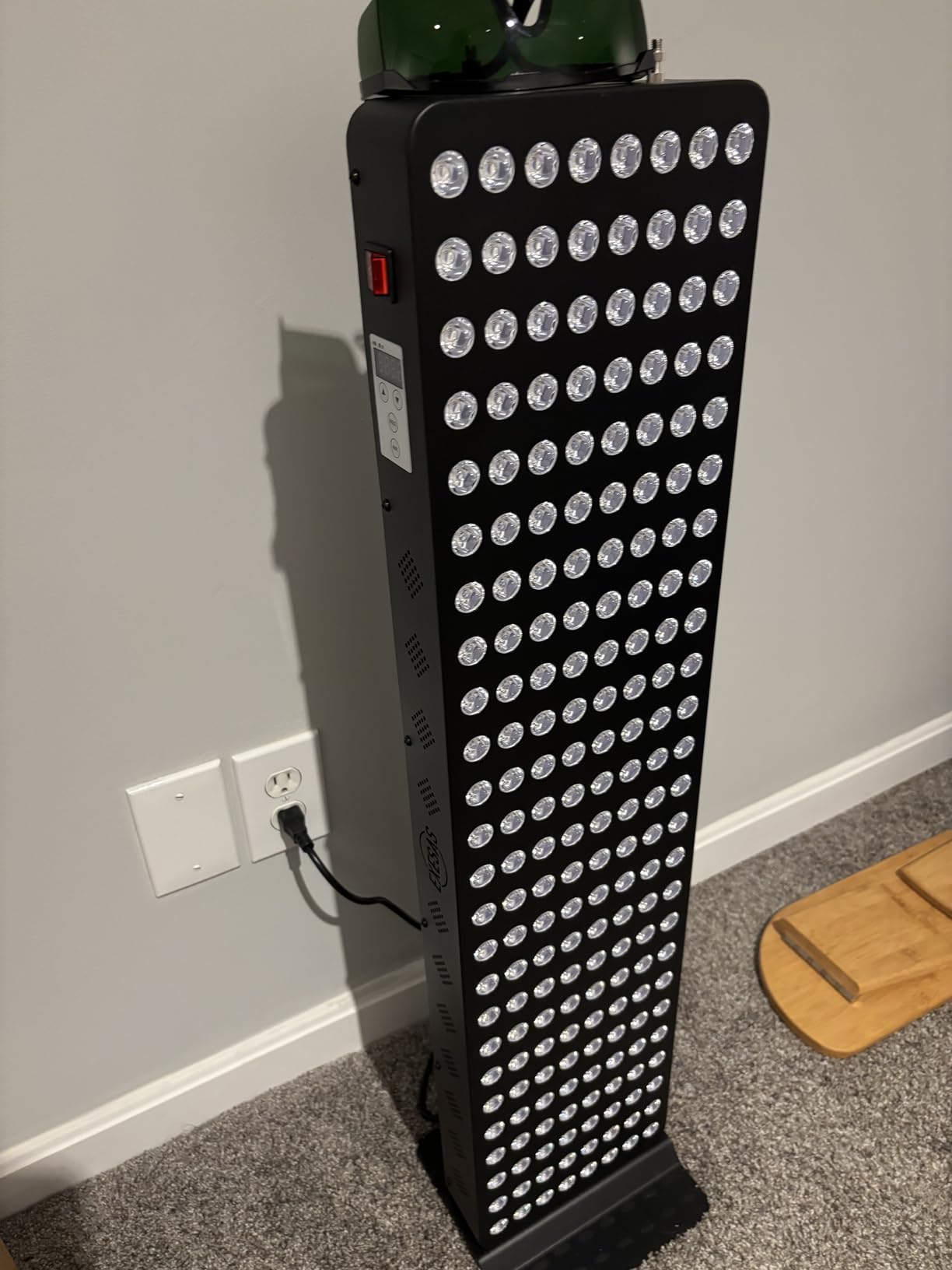
630nm: The Surface Wavelength
Penetration: 1-2mm — stays in the epidermis and very upper dermis.
What it’s used for: Skin texture, fine lines, hyperpigmentation, surface inflammation, acne management, post-procedure recovery (microneedling, peels).
Research base: Reasonable. 630nm shows up in dermatological photobiomodulation literature, often paired with 660nm. Multiple controlled studies on skin applications, though sample sizes vary.
The honest take: 630nm is the wavelength that justifies marketing photos of glowing faces. It’s genuinely useful for skin work because it doesn’t waste energy traveling past the layer you care about. If skin is your only goal, 630nm matters more than the deeper wavelengths.
But — and this is the part the marketing skips — 630nm alone won’t do anything for muscle pain, joint inflammation, or anything below the dermis. If you’re buying a panel primarily for muscle recovery and the spec sheet emphasizes 630nm, the marketing is misleading you about what you’ll actually feel.
Found in: Most multi-wavelength panels. The Hooga ULTRA1500, BestQool Pro300, and EXESAS 200-LED panel all include 630nm.
660nm: The Most-Studied Red Wavelength
Penetration: 2-3mm — reaches through the full dermis and into superficial blood vessels.
What it’s used for: Everything 630nm does, plus collagen synthesis, wound healing, scalp/hair applications, more substantial skin remodeling.
Research base: This is the deepest research base of any red wavelength in the photobiomodulation literature. If you’ve seen a study cited as evidence that “red light therapy works,” there’s a high chance 660nm was the wavelength used.
The honest take: 660nm is the workhorse red wavelength. If a panel only includes one red wavelength and it’s 660nm, that’s a reasonable choice. If it includes both 630nm and 660nm, you’re getting overlapping coverage with slightly different penetration profiles.
The collagen synthesis claims around red light therapy generally come from 660nm research specifically. Skin firmness, fine line reduction, post-procedure healing — most of that literature points back to 660nm or close wavelengths.
For hair-related applications (hair density, scalp circulation), 660nm has the strongest case. Some hair-specific devices use only 660nm because the dermis-level penetration matches where hair follicle bulbs sit.
Found in: Essentially every consumer panel worth buying. If a panel doesn’t include 660nm, that’s a red flag.
810nm: The Research Workhorse for NIR
Penetration: 3-4cm — reaches subcutaneous tissue, fascia, and shallow muscle.
What it’s used for: Muscle recovery, mitochondrial function, neurological applications (transcranial use), pain management, inflammation in shallow joints.
Research base: Largest published research base of any near-infrared wavelength used in consumer panels. Most photobiomodulation papers from researchers like Hamblin, Karu, and the major systematic reviews reference 810nm or wavelengths within a few nm of it.
The honest take: If you only get one NIR wavelength, 810nm is the most defensible choice from a research standpoint. The cellular mechanism research — cytochrome c oxidase activation, mitochondrial ATP production, the entire molecular basis for photobiomodulation — was largely characterized using wavelengths in the 808-810nm range.
The neurological photobiomodulation research (transcranial PBM for cognition, mood, and neurological conditions) uses 810nm almost exclusively. If you’ve seen a study about red light therapy and brain function, it was almost certainly 810nm.
For muscle recovery specifically, 810nm has solid evidence for reducing post-exercise inflammation markers and accelerating recovery between training sessions. The effect size in studies is modest but consistent.
Found in: Hooga ULTRA1500, EXESAS 200-LED panel, and most premium panels. Notably absent from the BestQool Pro300, which uses 940nm instead.
850nm: The Versatile Deep-Reach Wavelength
Penetration: 3-5cm — reaches deeper muscle and shallow joints.
What it’s used for: Muscle recovery, joint inflammation (knees, elbows, ankles), back pain, deeper tissue work where 810nm might not reach.
Research base: Solid. Less voluminous than 810nm but well-represented in muscle and joint applications specifically. Often paired with 810nm in studies that want to cover both shallow and slightly deeper tissue in one protocol.
The honest take: 850nm is the wavelength that makes a panel actually useful for the things people buy these things for — muscle and joint stuff. The penetration depth puts it in range of most non-deep musculoskeletal targets.
For knee work, lower back work, shoulder rotator cuff issues, 850nm reaches the relevant tissue depths. The combination of 810nm (more research backing) and 850nm (slightly deeper reach) is why many premium panels include both — they’re complementary, not redundant.
Found in: Hooga ULTRA1500, BestQool Pro300, EXESAS 200-LED panel — pretty much every multi-wavelength panel.
940nm: The Deep Tissue Specialist
Penetration: 5-7cm — reaches deep joints (hip, shoulder capsule), dense muscle tissue, and beyond.
What it’s used for: Deep joint applications (hip, shoulder), thick muscle bellies (glutes, hamstrings), anything where you specifically need light to travel several centimeters into tissue.
Research base: Thinner than 810nm or 850nm. The penetration depth is real physics — water absorption is favorable at 940nm relative to wavelengths just above it — but specific clinical studies on 940nm photobiomodulation outcomes are fewer in number.
The honest take: 940nm is the wavelength that’s hard to evaluate cleanly because the marketing case is “deeper is better” without strong specific evidence for what 940nm uniquely accomplishes that 850nm can’t.
What I’d say is this: if you have specific deep tissue applications in mind — chronic hip pain, shoulder capsule issues, work on dense muscle that 850nm hasn’t been touching — 940nm is a defensible addition. If you don’t have those specific applications, you’re paying for capability you may not use.
940nm doesn’t replace 810nm or 850nm. It supplements them. A panel that only had 940nm and skipped the other NIR wavelengths would be a worse choice than one with 810/850 only.
Found in: BestQool Pro300 is the notable inclusion in the panels I’ve reviewed. Hooga and EXESAS skip 940nm in favor of 810/850.
Which Wavelength Combinations Actually Make Sense
Now that the individual wavelengths are mapped, let me get specific about combinations and what they’re optimized for.
Two-Wavelength Combos (Budget Tier)
660nm + 850nm: This is the most common budget panel combo. It hits the most-studied red wavelength and the most versatile NIR wavelength. If a panel only has two wavelengths, this is the right two.
660nm + 810nm: Less common but defensible. Trades some depth for more research backing on the NIR side.
Avoid: Panels that only have 660nm + 940nm (skips the workhorse 810/850 NIR range), or panels with weird-only combos like 630nm + 660nm (no NIR coverage at all — useless for muscle/joint applications).
Four-Wavelength Combos (Mid to Premium Tier)
630 / 660 / 810 / 850 nm — The “research-backed everything” build. Two complementary red wavelengths for surface coverage, two complementary NIR wavelengths with the deepest research backing. This is what the Hooga ULTRA1500 and EXESAS 200-LED panel use.
Best for: General-purpose use, skin + muscle + shallow joints, anyone who wants the most research-supported wavelength choices.
630 / 660 / 850 / 940 nm — The “depth-focused” build. Trades 810nm for 940nm. You give up some research breadth on the NIR side but gain access to deeper tissue. This is what the BestQool Pro300 uses.
Best for: Users with specific deep tissue applications — hip joint work, shoulder capsule issues, deep muscle work that other panels haven’t been reaching.
Five-Plus Wavelength Combos
Some flagship panels add wavelengths like 590nm (yellow), 1064nm (deep NIR), or 480nm (blue). These are mostly diminishing returns for general use. Unless you have a specific application that targets one of these wavelengths, the four-wavelength panels deliver the same practical results at lower cost.
Single-Wavelength vs Multi-Wavelength Panels
You’ll occasionally see arguments that single-wavelength panels are “more focused” or that multi-wavelength panels “dilute” the dose. Both arguments are mostly marketing.
Multi-wavelength panels distribute LEDs across wavelengths. A 300-LED panel with four wavelengths typically has 75 LEDs at each wavelength. That’s still a lot of LEDs at each wavelength — enough to deliver therapeutic doses for each.
Different wavelengths reach different depths. A single-wavelength panel can only address one tissue depth. If you only care about that depth (some hair regrowth devices use only 660nm because hair follicles are at that depth), single-wavelength is fine. For general use covering skin AND muscle AND joints, multi-wavelength is genuinely better.
The only scenario where single-wavelength makes sense for general buyers is if you have a very specific, narrow application. For most people reading this, multi-wavelength panels are the right call.
Wavelength Marketing Red Flags to Watch For
Stuff that should make you skeptical of a panel’s spec sheet:
“Proprietary wavelength blend” — If they won’t list the actual wavelengths in nanometers, that’s a problem. Real panels publish specific wavelength values.
“850nm for all applications” — Single-wavelength claims of universal effectiveness are oversimplified. 850nm doesn’t work well on surface skin issues. 660nm doesn’t reach muscle.
“Includes therapeutic wavelengths from 400-1100nm” — If the panel actually emitted across that whole range, it would be a heat lamp. Real panels emit at specific peak wavelengths, not continuous spectra.
“Higher nm = better” — More nanometers isn’t better. 1500nm light barely penetrates anything because water absorption dominates. There’s an optimal range (roughly 600-1100nm), and within it, “better” depends on what tissue you’re targeting.
“Same as professional medical devices” — Maybe. Compare actual wavelengths and irradiance values, not the marketing copy.
How to Match Wavelengths to Your Goals
Here’s the practical framework. Pick what you’re actually trying to do, then check that the panel’s wavelength selection matches.
Skin-Focused (anti-aging, texture, post-procedure)
Need: 630nm and/or 660nm at sufficient irradiance for short-distance work.
NIR wavelengths nice but not critical.
Skip: Panels that emphasize NIR at the expense of red wavelength density.
Muscle Recovery (post-workout, training adaptation)
Need: 810nm and/or 850nm at therapeutic irradiance, ideally both.
Red wavelengths supplementary.
Skip: Red-only devices, “skin care” panels marketed for athletic recovery without genuine NIR output.
Joint Pain (knees, shoulders, elbows, ankles)
Need: 810nm + 850nm minimum. 940nm helpful for deeper joints (hip, shoulder capsule).
Sufficient irradiance to deliver therapeutic dose at 6-12 inches.
Skip: Panels with only red wavelengths, or panels with weak NIR output.
General Wellness (the marketing catch-all)
Need: Multi-wavelength panel with at least 660nm + 810nm/850nm.
Match panel size to body coverage goals.
Skip: Single-wavelength devices, panels with vague spec sheets.
Sleep and Circadian (NIR before bed, red light in evening)
Need: This is more about timing and avoiding blue/green light than wavelength selection. Any decent multi-wavelength panel works if used in the evening hours.
Skip: Panels with cool-white or “full spectrum” claims that include short wavelengths.
What Wavelength Choice Won’t Solve
Even with perfect wavelength selection, panels have inherent limitations.
Wavelengths are necessary but not sufficient. Having 660nm + 810nm + 850nm doesn’t help if irradiance is too low to deliver therapeutic dose, or if you only use the panel twice a week, or if you wear clothing during sessions and block 90% of the light.
Penetration depth varies between people. Skin tone, body composition, and tissue density all affect how deep light actually reaches in your specific body. The numbers I gave earlier are approximations.
More wavelengths isn’t strictly better. A four-wavelength panel with adequate irradiance per wavelength beats an eight-wavelength panel with diluted output per wavelength. Spec sheet count isn’t the same as functional benefit.
Eye protection requirements don’t vary by wavelength. All NIR wavelengths interact with retinal tissue. Use IR-blocking goggles regardless of which NIR wavelengths your panel emits.
Quick Reference: Wavelength Cheat Sheet
For the people who want one paragraph to remember:
630nm — Surface skin. Fine lines, texture. Stays in the epidermis. 660nm — Full dermis. Most-studied red wavelength. Collagen, wound healing, hair. 810nm — Shallow muscle, fascia. Most-studied NIR wavelength. Mitochondrial work. 850nm — Deeper muscle, shallow joints. The versatile NIR. Pairs well with 810nm. 940nm — Deep joints, thick muscle. Deepest penetration. Less research, real depth.
If you want a panel that handles general skin + muscle + joint applications, look for 660nm + 810nm + 850nm at minimum. If you want everything plus deep tissue capability, add 630nm and 940nm.
Recommended Panels by Wavelength Strategy
Based on the wavelength frameworks above, here’s how my reviewed panels map to use cases:
For research-backed everything (630/660/810/850nm):
- Hooga ULTRA1500 review — flagship-tier execution of this wavelength combo
- EXESAS 200-LED panel review — entry-tier execution of this wavelength combo
For depth-focused applications (630/660/850/940nm):
- BestQool Pro300 review — the only panel I’ve reviewed that includes 940nm
For direct head-to-head comparison:
- Hooga ULTRA1500 vs BestQool Pro300 — which wavelength strategy wins for which use case
If wavelength selection is the binding factor in your decision, the BestQool’s 940nm inclusion is the most differentiating wavelength choice in the price range. If you don’t specifically need deep tissue capability, the Hooga or EXESAS wavelength sets are more research-backed for general use.
Final Thought
Wavelength selection matters, but it’s one factor among several. A panel with perfect wavelength choices but inadequate irradiance, fan that’s too loud to use daily, or build quality that fails after a year is a worse buy than a panel with slightly less optimal wavelengths but solid execution everywhere else.
Use this guide to read spec sheets correctly. Then evaluate panels on irradiance, build, features, and price using the framework that wavelength selection has to enable the outcome you want, not guarantee it.
If a panel’s wavelengths don’t include the depths you actually need, it’s the wrong panel regardless of how good everything else looks. If the wavelengths are right and the rest of the spec sheet is competitive, you’ve found a candidate worth serious consideration.
For specific panel evaluations using this framework, see my full reviews of the Hooga ULTRA1500, BestQool Pro300, and EXESAS 200-LED panel.
Disclosure: This site contains affiliate links. Purchases through these links may generate a commission at no extra cost to you.
This content is for informational purposes only and does not constitute medical advice. Photobiomodulation research is ongoing, and specific outcomes vary by individual. Consult a qualified healthcare provider before starting any new wellness protocol. These statements have not been evaluated by the FDA and are not intended to diagnose, treat, cure, or prevent any disease.