I woke up this morning with that familiar stiffness in my lower back—the kind that tells you you’re not twenty anymore and that yesterday’s DIY project involved a lot more bending than your body was prepared for. My coffee is lukewarm because I got distracted staring at the massive red glow emanating from my bedroom corner. The BestQool Pro300 is humming away, its 300 elite-grade dual-chip LEDs casting a crimson hue across the room that makes me feel like I’m in a sci-fi movie. Or maybe a tanning salon from hell. I’m not sure yet.
I’ve been using this thing for a few weeks now, and I have thoughts. A lot of them. Some good, some skeptical, and one very specific complaint that I’ll get to because you deserve to know before you drop nearly $900 on a panel that’s basically a really expensive nightlight with aspirations.
Why I Even Looked at This Thing
Let me back up. I’ve been down the red light therapy rabbit hole before. I wrote about the Hooga Pro300 red light therapy panel a while back, and honestly, I was impressed. But I’m also a sucker for “more.” More LEDs, more wavelengths, more power. The BestQool Pro300 promised all of that—300 LEDs, four wavelengths (630, 660, 850, and 940 nm), and a reported power consumption of 470 watts that supposedly translates to stronger effects. I was curious. Skeptical, but curious. And maybe a little desperate for something that actually works.
I’d also tried cheaper panels. The Exesas 200 LED panel was fine for small areas, and the Bontanny BO-2400 had its moments, but neither felt like they could do the full-body coverage thing convincingly. The BestQool is bigger. Way bigger. And I was hoping that bigger meant better.
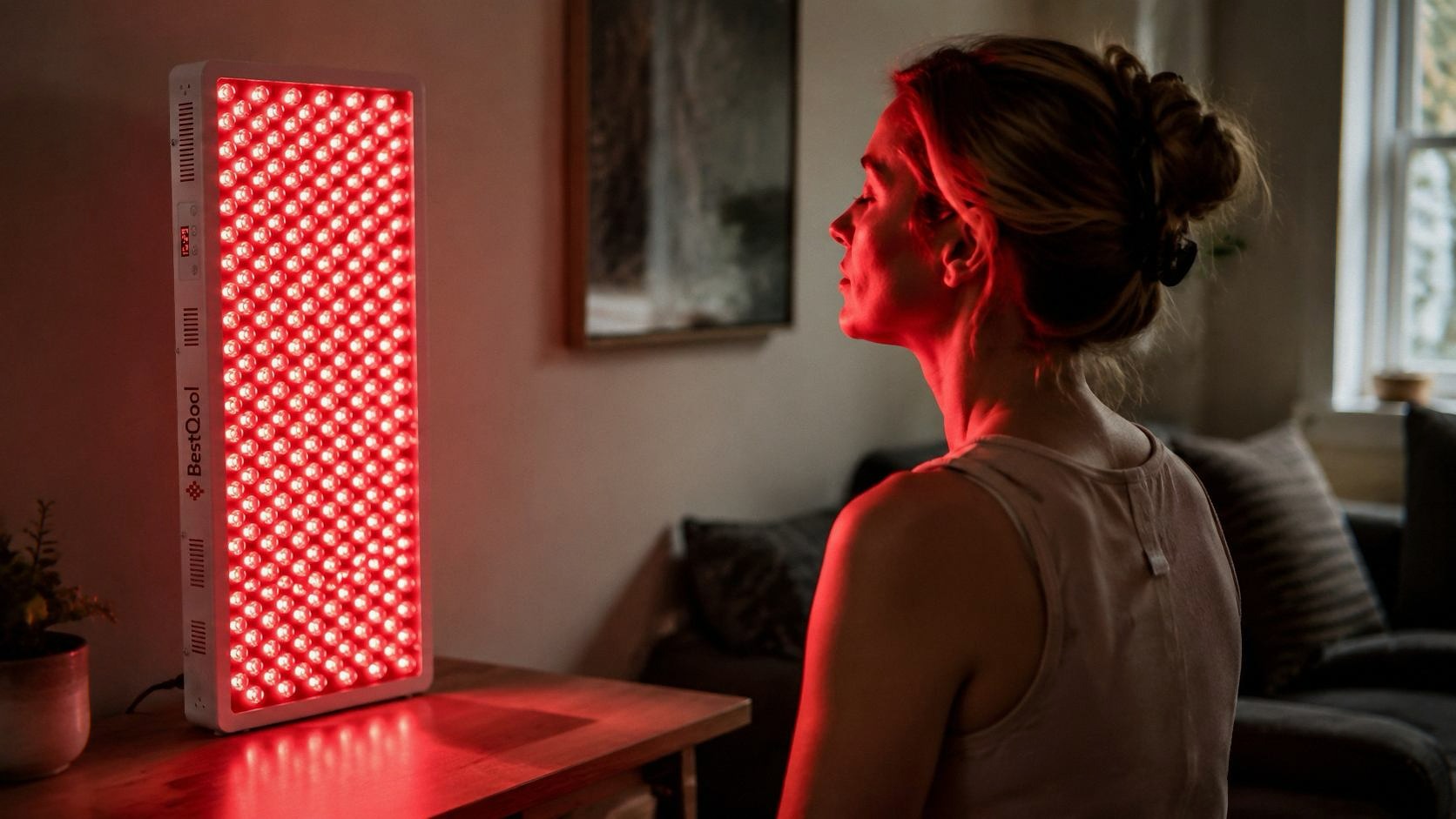
Unboxing: Heavy, Solid, and a Little Intimidating See Today’s Deal on Amazon
The box arrived and I nearly threw my back out bringing it inside. 19.1 pounds. That’s not a panel—that’s a commitment. Inside, the Pro300 is wrapped in that satisfyingly dense foam, and it immediately feels different from the cheaper panels I’ve handled. The aluminum casing is sturdy, the LED array is pristine, and the build quality is genuinely impressive. It’s not flimsy. It feels like someone put thought into it.
And then I pulled out the accessories. This is where things got… interesting.
The panel comes with hanging hooks, adjustable steel cables, and instructions that suggest you mount it on a door. Let me repeat that: a door. Like a regular, interior door. You use the cables to hang the panel from the top of the door, and then you adjust its height using these little rope-and-pulley contraptions. And here’s the thing—it works. Sort of. But it’s absurd. This is a $900 device, and you’re telling me my best option is to hang it like a goddamn shower curtain?
I tried the door mounting approach. I really did. I hung the panel, stood in front of it, and felt like I was in some kind of medieval torture chamber. The cables kept slipping. The panel tilted at an awkward angle. And I couldn’t shake the mental image of the whole thing crashing down in the middle of the night, scaring the hell out of my cat and destroying itself on the hardwood floor. No thanks.
The manual didn’t help either. It’s a mix of self-congratulatory origin story—about some founder who apparently overcame immense hardship to bring this gift to humankind—and vague instructions that left me scratching my head. It’s like reading a LinkedIn post written by a motivational speaker who also happens to be your high school physics teacher. Just tell me how to turn it on, man.
The Stand Problem (and Why It Nearly Got a Return)
Here’s my biggest gripe: the panel doesn’t come with a stand. You get a door mount system that feels janky, and that’s it. If you want a proper stand that lets you position the panel at a reasonable height and angle without engineering a Rube Goldberg contraption, you’re looking at spending another $300. THREE HUNDRED DOLLARS. For a piece of metal.
I can’t be the only one who finds this infuriating. The customer reviews confirm it—there’s a whole rant about this exact issue. The panel is heavy. It’s tall (36.4 inches). You can’t just prop it against a wall and hope for the best. It will slip. It will fall. You will break it.
I ended up building a makeshift stand out of a sturdy wooden easel I had lying around. It’s not elegant, but it works. The panel sits at a comfortable height, I can angle it to cover my whole body, and I don’t have to worry about it crashing down on me mid-session. But the fact that I had to MacGyver my own solution for an $844 product is ridiculous. If you’re buying this, factor in the cost of a stand or be prepared to get creative.
The Light Experience: What 300 LEDs Actually Feel Like
Okay, deep breath. Complaints aside, let’s talk about what this thing actually does.
The BestQool Pro300 has four wavelengths: 630nm (red, surface-level), 660nm (red, a bit deeper), 850nm (near-infrared, deep tissue), and 940nm (near-infrared, even deeper). The idea is that different wavelengths penetrate to different depths, hitting everything from your skin to your muscles to your joints. It’s not just a one-trick pony; it’s a full-body assault on inflammation and cellular dysfunction.
When you turn it on, it’s bright. Like, “don’t stare directly at it” bright. The included goggles are non-negotiable. I tried looking at the panel without them once, and my eyes were seeing spots for a solid ten minutes. Wear the goggles. Trust me.
The warmth is noticeable but not uncomfortable. It’s like standing in front of a fireplace that’s just far enough away to be pleasant. I usually do 15-20 minute sessions, standing about six inches from the panel. The coverage is impressive—the panel is 46.5 inches wide and 17.4 inches tall at a six-inch distance, which covers my entire torso and most of my legs in one go. No repositioning, no messing around.
And here’s the thing: it feels good. It really does. There’s something deeply relaxing about standing in that warm red glow. I’ve found myself looking forward to my daily sessions. It’s become this little ritual, a pause in the chaos of the day. The fan is audible but not annoying—I can still hear the TV over it, which is more than I can say for some other devices I’ve tried.
Did It Actually Do Anything?
This is the million-dollar question, right? Does red light therapy actually work, or is it just expensive placebo?
Here’s what I noticed:
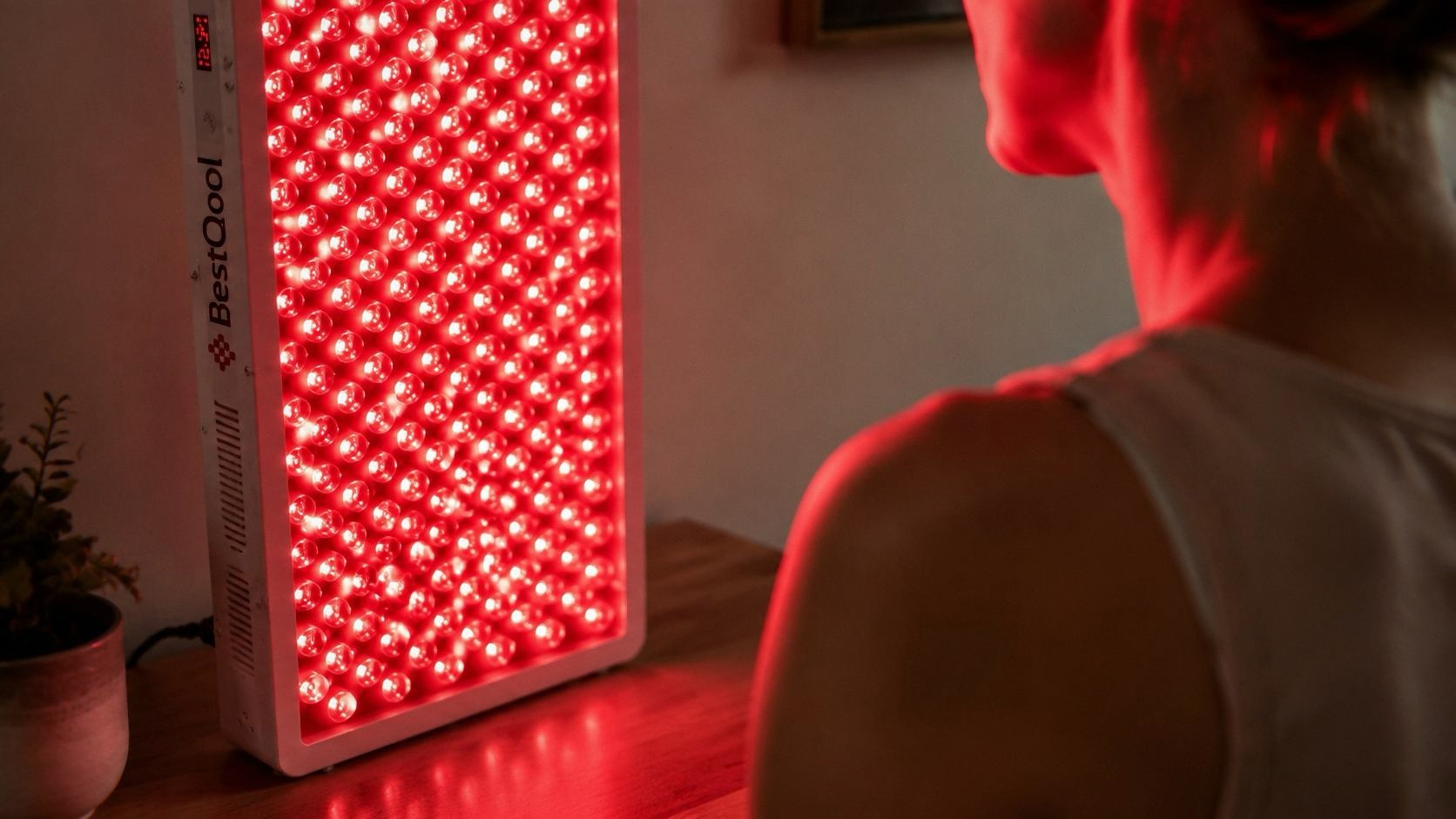 Muscle recovery: I started using the panel after my workouts—usually a mix of weights and some cardio. The difference was subtle at first, but after about a week, I noticed that my legs weren’t as sore the next day. That dull ache that usually accompanies leg day was… less. Not gone, but diminished. I’ll take it.
Skin improvements: This one surprised me. My skin looks brighter. A bit more even. The fine lines around my eyes seem less pronounced, though that could be wishful thinking. A few people have commented that I look “well-rested” in the last couple of weeks, which is hilarious because I’m definitely not sleeping more. So maybe it’s the light. Or maybe it’s the placebo effect. I don’t really care which—the result is the same.
Back pain: Remember that lower back stiffness I mentioned? It’s better. Not cured, but better. I’ve been focusing the panel on my lower back for about ten minutes each session, and the difference is noticeable. I’m not hobbling around like an old man in the mornings anymore.
Energy levels: This is the weird one. I feel more alert in the mornings after a session. Not jittery or caffeinated, just… awake. I can’t explain it. One of the reviewers mentioned that their morning fatigue vanished after using the panel, and I’m starting to think they might be onto something.
One of the BestQool reviews compared this panel to the much more expensive Platinum LED Biomax 900 and claimed the Pro300 actually puts out more joules of light. I can’t verify that. I don’t have a light meter. But I can say that it feels powerful. You can sense the intensity. It’s not messing around.
The Honest Downsides (Because There Are Always Downsides)
-
The mounting situation is a disaster. I’ve already ranted about this, but it bears repeating. No stand is a dealbreaker for some people. If you don’t have a creative solution ready, you’ll be frustrated.
-
It’s heavy and awkward to move. 19 pounds is a lot, and the panel’s shape makes it unwieldy. If you’re planning to use it in different rooms, you’re going to get a workout just moving it around.
-
The instruction manual is terrible. It’s long, rambling, and not particularly helpful. I basically ignored it and figured things out on my own. The safety documents are fine, but the user guide could be a lot clearer.
-
It’s expensive. Yes, it’s cheaper than some competitors, but $844 is still a significant investment. If you’re on the fence, I’d recommend starting with a smaller, cheaper panel like the Hooga Pro300 and seeing if red light therapy works for you before going all-in on this beast.
-
The 940nm wavelength is a bit of a mystery. The research on 940nm is less robust than the other wavelengths. It’s promising, but we don’t know as much about its specific effects. BestQool includes it anyway, which is either forward-thinking or a marketing gimmick.
Who Should Actually Buy This Thing?
If you’re looking for a device that can cover your entire body in one session, the Pro300 is hard to beat. It’s powerful, well-built, and delivers on its promises. The four wavelengths give you flexibility, and the half-body coverage means you’re not spending 45 minutes moving a smaller panel around.
But I have to be honest: if you’re just starting out with red light therapy, or if you’re only targeting a small area like your face or a specific joint, this is overkill. You’d be better off with something like the Hooga Ultra1500 (which I reviewed here) or even a smaller panel like the Exesas 200. The Pro300 is for people who are committed. People who want the big guns. People who are ready to spend the money and figure out the logistics.
[If you grab one through the links here, I might get a small cut — costs you nothing extra and keeps the lights on.]
What I’d Tell a Friend See Today’s Deal on Amazon
I’d look them dead in the eye and say: “This thing is amazing, but it’s a pain in the ass to set up. If you can get past the mounting nonsense and the vague instructions, you’ll love it. Your skin will look better, your muscles will recover faster, and you might actually feel better overall. But don’t buy it unless you’re prepared to deal with the stand situation or build your own solution.”
And then I’d hand them my phone to show them the Hooga Pro300 and say, “Maybe start with this. It’s cheaper, it’s smaller, and it doesn’t require you to turn your door into a full-body light therapy station. If you outgrow it, then come back to the BestQool.”
Three weeks in, and I’m still using it every day. The glow is nice. The results are subtle but real. And I’ve mostly stopped worrying about it falling off my easel contraption. Mostly.
Anyway, I think I need to go figure out a better stand solution. My wife is starting to give me sideways looks about the easel in the bedroom.
Worth it. Moving on.